
In this article
Introduction
Why Smaller Destinations Often Struggle Internationally
The Budget Myth in Destination Marketing
Why Strategy Matters More Than Spending
Building a Stronger Tourism Identity
What Makes Smaller Destinations Competitive
The Power of Niche Positioning
Why Generic Promotion No Longer Works
Creating Clear Destination Storytelling
Smart International Growth
Strategic Partnerships Over Expensive Advertising
Choosing the Right Tourism Trade Fairs
Why B2B Relationships Matter
The Importance of Long-Term Market Presence
Practical Destination Strategy
How Smaller DMOs Can Use Agility as an Advantage
Aligning Tourism Stakeholders Around One Vision
Building Consistency Across Markets
Thinking Beyond Campaigns and Visibility
Key Takeaways & Future Growth
What Successful Smaller Destinations Do Differently
Why Authenticity Has Become a Competitive Advantage
The Future of International Destination Marketing
Final Strategic Thoughts
Related services
• Trade Representation & B2B Growth
• Partnership Development
Let’s talk strategy
“The destinations that compete successfully internationally are not always the ones with the biggest budgets.
They are the ones with the clearest identity, the smartest partnerships, and the strongest strategic focus.”
— Addendum
How DMOs Can Compete Internationally Without Huge Budgets
May 11, 2026 • 8 min read • By Addendum
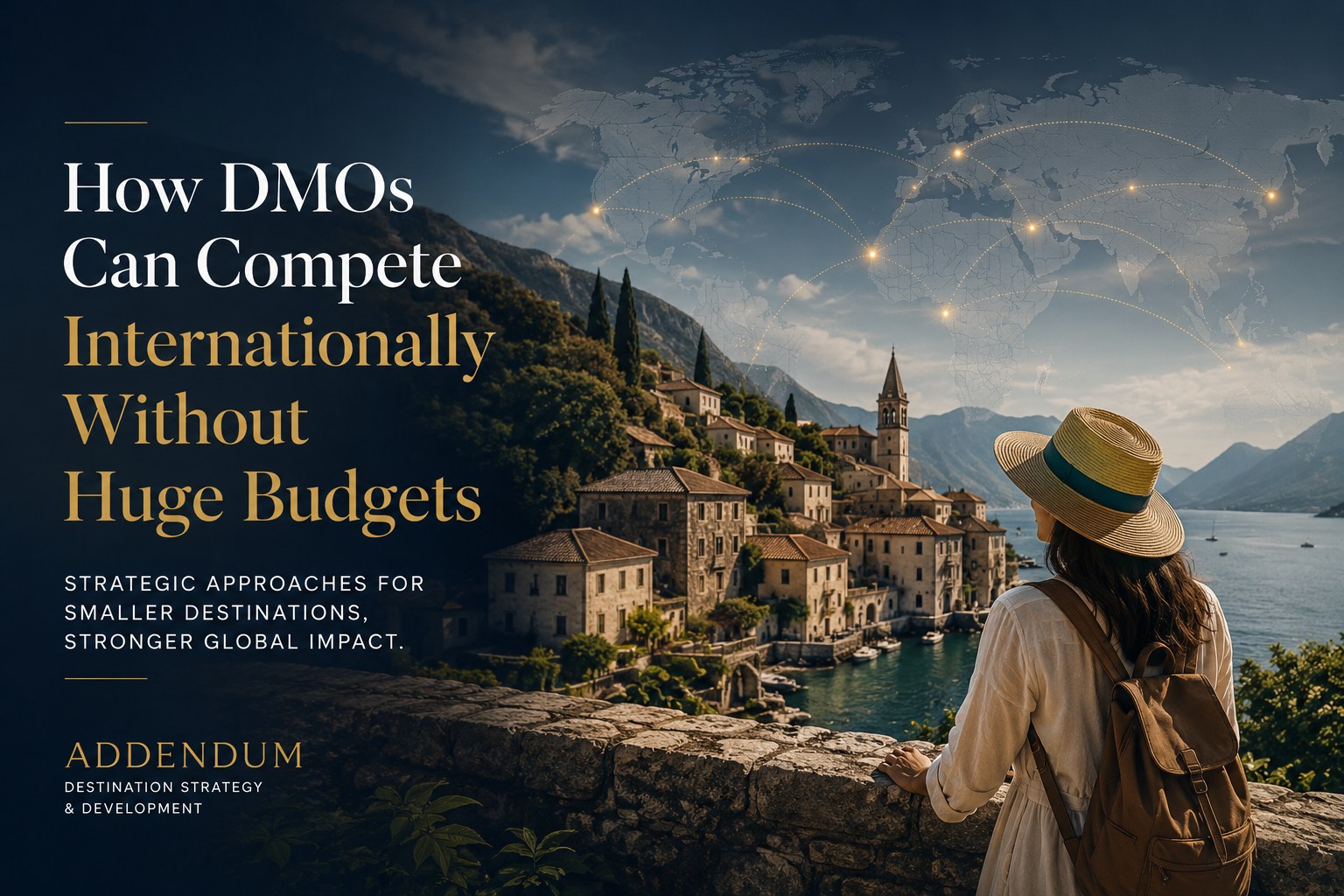
For many destinations, international tourism marketing can feel like an uneven competition. Large tourism boards launch multi-million-euro campaigns, dominate major exhibitions, collaborate with global media brands, and maintain a constant international presence across markets. Smaller destinations, municipalities, regional tourism organizations, and emerging DMOs often assume they simply cannot compete at the same level.
But in reality, budget is not always the factor that determines international success.
Some of the world’s most recognizable and commercially successful destinations are not necessarily the ones spending the most money. They are the ones with the clearest positioning, the strongest storytelling, the smartest partnerships, and the most focused tourism strategy.
In today’s tourism landscape, smaller destinations can compete internationally — and in many cases outperform larger competitors — when they stop trying to imitate everyone else and start leveraging what makes them genuinely distinctive.
The real challenge for many DMOs is not the absence of budget. It is the absence of strategic focus.
The Tourism Industry Has Become More Competitive — But Also More Open
The global tourism market has changed dramatically during the past decade. Travelers are increasingly searching for authentic experiences, local culture, outdoor activities, wellness, gastronomy, sustainability, and meaningful travel rather than mass-market tourism alone.
This shift has created enormous opportunities for smaller destinations.
Large tourism brands may have stronger advertising power, but they often struggle to appear authentic, flexible, or emotionally distinctive. Smaller destinations, on the other hand, frequently possess:
- stronger local identity,
- authentic experiences,
- emotional storytelling potential,
- niche tourism opportunities,
- and closer connections between tourism stakeholders.
These are increasingly valuable assets in modern destination marketing.
The destinations gaining attention internationally today are often not the loudest. They are the clearest.
Bigger Budgets Do Not Automatically Create Stronger Tourism Brands
One of the biggest misconceptions in destination marketing is the belief that visibility alone creates tourism growth.
In reality, many destinations spend heavily on campaigns without first building:
- a clear tourism identity,
- strong market positioning,
- differentiated messaging,
- or commercially relevant tourism products.
As a result, large budgets are often fragmented across disconnected campaigns, generic promotion, and inconsistent communication.
Smaller DMOs sometimes believe they need to “do everything” to compete internationally. However, the opposite is often true.
The destinations that perform best are usually the ones that understand:
- who they are,
- which audiences they want to attract,
- what makes them different,
- and how to communicate that consistently.
Strategic clarity almost always outperforms marketing noise.
The Real Advantage of Smaller Destinations: Agility
One of the greatest hidden strengths of smaller destinations is agility.
Large tourism organizations frequently move slowly due to bureaucracy, multiple approval layers, political changes, and complex organizational structures. Smaller destinations often have the ability to react faster, test new ideas more quickly, and create more flexible tourism initiatives.
This flexibility matters enormously in modern tourism marketing.
Travel trends evolve rapidly. Consumer behavior changes constantly. Markets shift. Airline routes change. New tourism segments emerge.
Smaller destinations that monitor market trends carefully and respond strategically can position themselves far more effectively than destinations operating through rigid structures.
In many cases, international success comes not from size, but from adaptability.
Why Niche Positioning Is More Powerful Than Broad Promotion
One of the most common mistakes DMOs make is trying to appeal to everyone.
Generic tourism messaging rarely creates strong market perception. Statements such as:
- “something for everyone,”
- “beautiful beaches,”
- “rich culture,”
- or “warm hospitality”
have become interchangeable across the global tourism industry.
Modern travelers and international buyers are increasingly looking for specialization.
Destinations that successfully compete internationally often focus on clear tourism pillars such as:
- adventure tourism,
- gastronomy,
- wellness,
- hiking,
- cycling,
- luxury escapes,
- cultural routes,
- wellness retreats,
- digital nomad experiences,
- sailing,
- sustainable tourism,
- or authentic rural experiences.
Niche positioning does not limit a destination. It strengthens recognition.
A destination that becomes strongly associated with a specific experience category gains much stronger visibility in international markets than one trying to communicate everything simultaneously.
Strategic Partnerships Matter More Than Expensive Advertising
One of the smartest ways smaller destinations can expand internationally without massive budgets is through partnerships.
Strategic tourism growth today is increasingly built through collaboration rather than isolated promotion.
Strong partnerships may include:
- airlines,
- tour operators,
- media,
- content creators,
- tourism associations,
- chambers,
- hotels,
- local stakeholders,
- international organizations,
- and neighboring destinations.
Partnerships create leverage.
A well-designed co-marketing campaign with an airline or tour operator can sometimes generate greater long-term value than a large standalone advertising campaign.
Similarly, participation in strategic industry initiatives, international workshops, fam trips, B2B marketplaces, and hosted buyer programs can create visibility far beyond what traditional advertising budgets allow.
The destinations that grow internationally are often the ones that build ecosystems — not isolated campaigns.
Tourism Exhibitions Should Be Strategic — Not Symbolic
International tourism exhibitions remain valuable tools for market development, but smaller destinations must approach them strategically.
Attending every exhibition is rarely effective.
Instead, DMOs should focus on:
- the right markets,
- the right buyer profiles,
- the right tourism segments,
- and the exhibitions that align most closely with their positioning.
A smaller destination with strong preparation, targeted appointments, and clear storytelling can generate significantly better B2B results than a larger destination attending without strategy.
This is especially important because exhibitions today are increasingly relationship-driven rather than visibility-driven.
The quality of meetings matters far more than the size of the stand.
Storytelling Is One of the Most Undervalued Competitive Advantages
Modern destination marketing is no longer only about promotion. It is about perception.
Travelers are not simply choosing destinations. They are choosing emotions, identities, lifestyles, and experiences.
This is where smaller destinations often possess extraordinary advantages.
Smaller places tend to have:
- more authentic stories,
- stronger local personalities,
- emotional cultural narratives,
- genuine hospitality,
- and deeper connections between visitors and communities.
The challenge is translating these assets into strategic storytelling.
Effective tourism storytelling should not simply describe a destination. It should explain:
- why the destination matters,
- what type of traveler it attracts,
- what emotional experience it offers,
- and why it is different from competitors.
The destinations that communicate emotionally and consistently are often the ones that remain memorable internationally.
International Visibility Is Built Through Consistency
One of the biggest mistakes smaller DMOs make is expecting immediate results from isolated actions.
Real destination positioning takes time.
International market development is built gradually through:
- repeated visibility,
- consistent messaging,
- ongoing relationships,
- strategic partnerships,
- media exposure,
- B2B networking,
- and long-term credibility.
This means smaller destinations should stop comparing single campaigns against larger competitors and instead focus on building sustained market presence over time.
Consistency creates trust.
And in tourism, trust is one of the strongest drivers of commercial success.
Why Smaller Destinations Often Create Stronger Experiences
Ironically, some of the most desirable travel experiences today are found in smaller, less commercialized destinations.
Travelers increasingly seek:
- authenticity,
- slower travel,
- local culture,
- nature,
- human connection,
- sustainability,
- and experiences that feel personal rather than mass-produced.
This trend creates enormous opportunities for smaller destinations willing to position themselves strategically.
The tourism industry is gradually shifting away from pure volume toward value, quality, and meaningful experiences.
Destinations that understand this transition early will have significant long-term advantages.
How DMOs Can Start Competing More Strategically
Smaller destinations do not need to imitate larger tourism brands to succeed internationally.
Instead, they should focus on:
- clearer positioning,
- stronger storytelling,
- strategic partnerships,
- focused market selection,
- niche specialization,
- consistent communication,
- and long-term relationship building.
The future of destination marketing will not belong only to the destinations with the biggest budgets.
It will belong to the destinations with the clearest identity, the smartest strategy, and the strongest ability to create emotional connection in increasingly competitive international markets.
For DMOs willing to think strategically rather than simply spend aggressively, the opportunities are enormous.