
In this article
FAM Trips, Not Fun Trips
Why Most Destination Familiarisation Visits Fail to Generate Business
- Executive Introduction
When Hospitality Becomes the Goal Instead of the Tool - Why Most FAM Trips Fail
Why hospitality alone rarely creates measurable commercial outcomes. - From Hosted Visit to Business Development Programme
Smaller groups, careful participant selection and strategic planning. - Preparation Starts Months Before Arrival
Market intelligence, buyer qualification, virtual B2B meetings and tailored itineraries. - The Power of a Physical B2B Marketplace
Connecting the right international buyers with the right local tourism businesses through structured one-to-one meetings. - Measuring Success
Replace satisfaction with KPIs such as partnerships, new itineraries, contracts and estimated visitor value. - Case Study: Strategy Replaced Scale
How one destination achieved stronger commercial results by reducing participant numbers and focusing on quality over quantity. - The Addendum Framework for High-Performing FAM Trips
(Your infographic and strategic process.) - Hospitality Creates Memories. Strategy Creates Business.
Final strategic thoughts and key takeaways. - Complimentary FAM Trip Strategy Review
Custom CTA.
Related services
• Trade Representation & B2B Growth
• Partnership Development
Let’s talk strategy
Planning a fam trip, campaign, exhibition presence, or B2B outreach? Let’s discuss how Addendum can support your destination.
“The most successful FAM trips are designed backwards—from the commercial outcomes they aim to achieve, not from the itinerary they plan to deliver.”
— Addendum
FAM Trips, Not Fun Trips. Why Most Destination Familiarisation Visits Fail to Generate Business
July 11, 2026 • 12 min read • By Addendum
What is a FAM Trip?
A FAM (Familiarization) Trip is a hosted visit organized by a destination, tourism board, hotel or travel company to help travel professionals, tour operators, travel advisors, journalists and content creators experience a destination firsthand. The objective is to generate future business, media coverage and visitor demand—not simply to provide a complimentary holiday.
When Hospitality Becomes the Goal Instead of the Tool
Every year, Destination Management Organizations (DMOs), Tourism Boards and Regional Tourism Organizations invest significant time, effort and financial resources in organising familiarisation trips. Tour operators, travel advisors, destination management companies, journalists and content creators are invited to experience a destination through carefully curated itineraries, premium accommodation, memorable gastronomy and authentic local experiences.
For many destinations, these programmes represent one of the largest annual investments in international market development. They are designed to showcase the destination at its very best, strengthen relationships with the travel trade and ultimately generate new business opportunities.
Yet despite these ambitions, one important question is rarely asked once the programme concludes.
Did the FAM trip actually generate business?
Too often, destinations measure success by indicators that are easy to observe but difficult to connect with commercial outcomes. Participants praise the accommodation, share beautiful photographs on social media, compliment the organisation and leave with positive impressions. These are all encouraging signs, but they do not necessarily translate into new tourism products, brochure inclusions, commercial agreements or increased visitor arrivals.
A successful FAM trip should never be evaluated simply by how much participants enjoyed the experience.
It should be evaluated by what happened after they returned home.
Did a tour operator launch a new itinerary? Did a travel advisor begin actively promoting the destination? Did a journalist publish meaningful editorial coverage that reached the destination’s priority audience? Did local tourism businesses establish new partnerships that continued long after the visit had ended?
These are the outcomes that justify the investment.
The challenge is that many destinations approach familiarisation trips primarily as hospitality programmes rather than strategic business development initiatives. Significant resources are devoted to accommodation, dining experiences and sightseeing, while considerably less attention is given to participant qualification, commercial matchmaking, structured business meetings and post-trip relationship management.
Hospitality is undoubtedly important. Every destination should strive to create memorable experiences that genuinely reflect its identity and values.
However, hospitality is not the objective.
It is the tool.
The objective is sustainable commercial growth.
This distinction fundamentally changes how a FAM trip should be designed.
Instead of asking, “How can we impress our guests?”, destinations should begin by asking a far more strategic question:
“Which international partners have the greatest potential to generate measurable value for our destination, and how can this programme help us build long-term business relationships with them?”
Once this question becomes the starting point, every aspect of the programme begins to change. Participant selection becomes more strategic. Itineraries become more relevant. Meetings become more purposeful. Local tourism businesses become active participants rather than passive hosts. Success is measured through partnerships, contracts and market development instead of compliments and photographs.
In other words, a FAM trip stops being an event.
It becomes a carefully designed business development programme.
And that is precisely why so many destination familiarisation visits fail to deliver the commercial impact they were originally intended to achieve.
Why Most FAM Trips Fail
At first glance, many familiarisation trips appear highly successful. Participants leave enthusiastic, social media is filled with beautiful imagery, local stakeholders receive positive feedback and organisers conclude that the programme achieved its objectives.
Unfortunately, this perception is often misleading.
The real success of a FAM trip cannot be measured during the visit itself. It can only be measured months later, when the destination evaluates whether the relationships established have translated into tangible commercial outcomes.
Has the destination secured new tour operator programmes? Have travel advisors begun actively recommending the destination? Has the destination been included in new brochures, online itineraries or package holidays? Have local businesses developed lasting partnerships with international buyers? Has media exposure reached the intended audience and influenced travel decisions?
In many cases, the answer is disappointingly limited.
This does not necessarily mean that the FAM trip was poorly organised. On the contrary, many destinations deliver exceptional hospitality, flawless logistics and unforgettable experiences. The problem lies elsewhere.
The programme was designed to impress rather than to produce measurable business results.
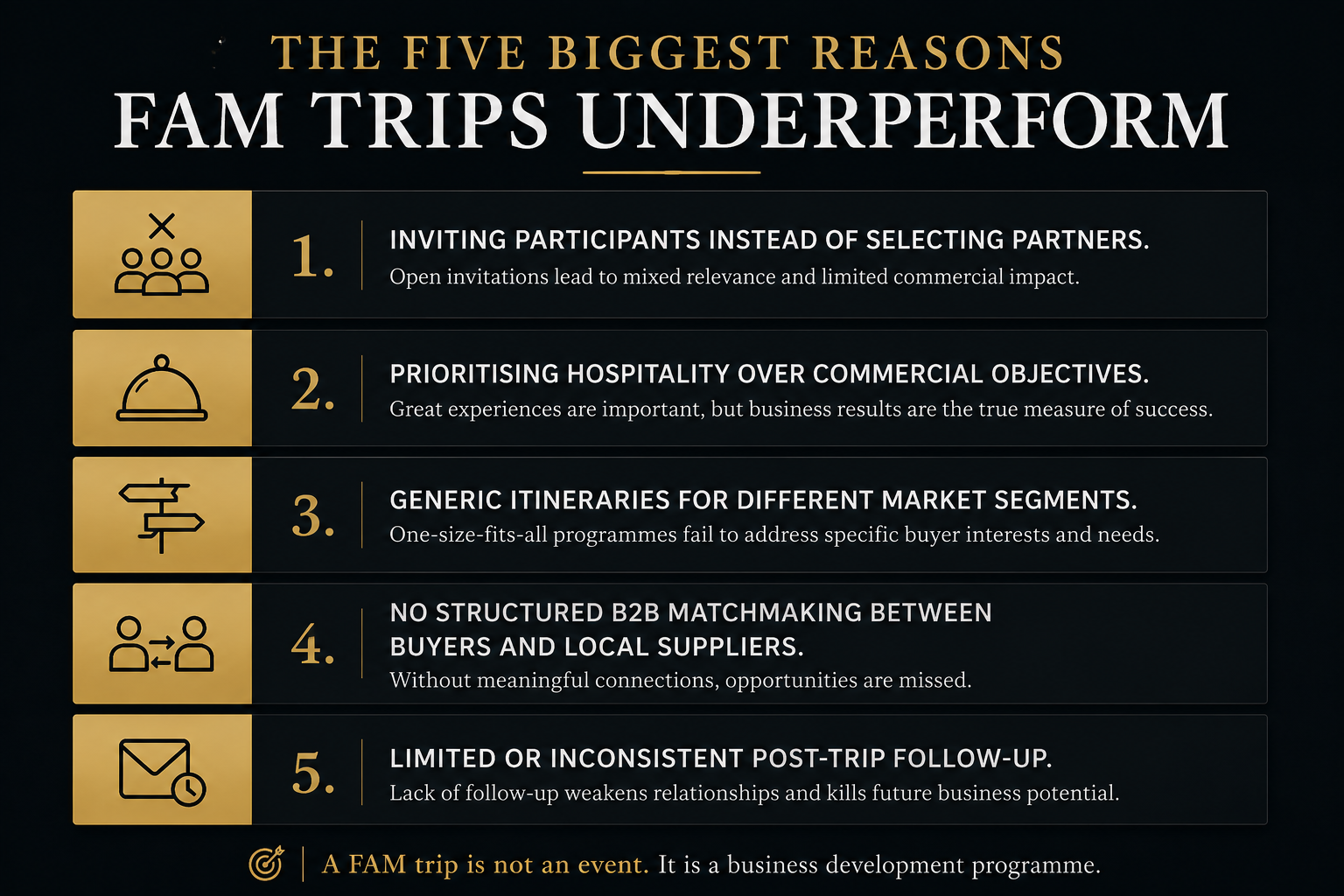
One of the most common mistakes is attempting to satisfy everyone. Destinations often invite participants representing different markets, different travel segments and different commercial interests, then present exactly the same programme to all of them. Luxury travel specialists, adventure operators, cultural tourism experts and family travel advisors follow identical itineraries, attend the same site visits and participate in the same activities, despite serving completely different audiences.
While this approach may simplify logistics, it significantly reduces commercial relevance.
A destination should never try to show everything.
It should focus on demonstrating exactly what matters to the people sitting in front of it.
Another frequent mistake is confusing exposure with opportunity.
Many destinations believe that simply bringing international buyers to the destination will naturally generate business. In reality, relationships do not develop automatically because people travelled together for a few days. Successful commercial partnerships require structured conversations, a clear understanding of each buyer’s portfolio, realistic discussions about market potential and direct introductions to the local businesses that best match their commercial needs.
Without this strategic matchmaking, even the most impressive itinerary risks becoming little more than an educational excursion.
Participant selection is another area where destinations often underestimate the importance of quality over quantity.
A larger group may appear more impressive on paper, but larger groups rarely create better business outcomes. As participant numbers increase, opportunities for meaningful discussions decrease. Local suppliers have less time with each buyer, itineraries become more generic and organisers inevitably focus more on logistics than on relationship building.
A carefully curated group of ten highly qualified buyers with genuine commercial interest will almost always deliver greater long-term value than thirty participants whose relevance to the destination has not been properly assessed.
Equally important is what happens before participants even board the plane.
Many FAM trips begin with the arrival of the guests. In reality, the commercial journey should begin months earlier. Destinations should already know who these buyers are, what products they sell, which customer segments they serve, what challenges they face and where genuine opportunities for collaboration exist. Early communication allows both sides to determine whether a hosted visit is likely to lead to meaningful business rather than simply providing another familiarisation experience.
Perhaps the biggest weakness of many programmes, however, is what happens after the visit ends.
Once participants return home, communication often becomes sporadic or disappears altogether. Follow-up emails are delayed, promised information arrives weeks later and valuable conversations gradually lose momentum as participants return to their daily responsibilities. By the time the destination reaches out again, the enthusiasm created during the visit has often faded.
Successful destinations understand that the return flight does not mark the conclusion of the FAM trip.
It marks the beginning of the commercial relationship.
Ultimately, most FAM trips do not fail because destinations lack hospitality, passion or commitment. They fail because they are designed as promotional events rather than strategic business development programmes.
Changing this mindset changes everything.
When destinations begin planning with commercial objectives instead of hospitality alone, every decision becomes more purposeful. Invitations become more selective. Itineraries become more relevant. Meetings become more productive. Follow-up becomes systematic. Most importantly, the investment begins generating measurable long-term value instead of short-lived impressions.
Because at the end of the day, a successful FAM trip is not remembered for the dinner that received the loudest applause.
It is remembered for the partnerships that continued long after the last guest had returned home.
From Hosted Visit to Business & Destination Development Programme
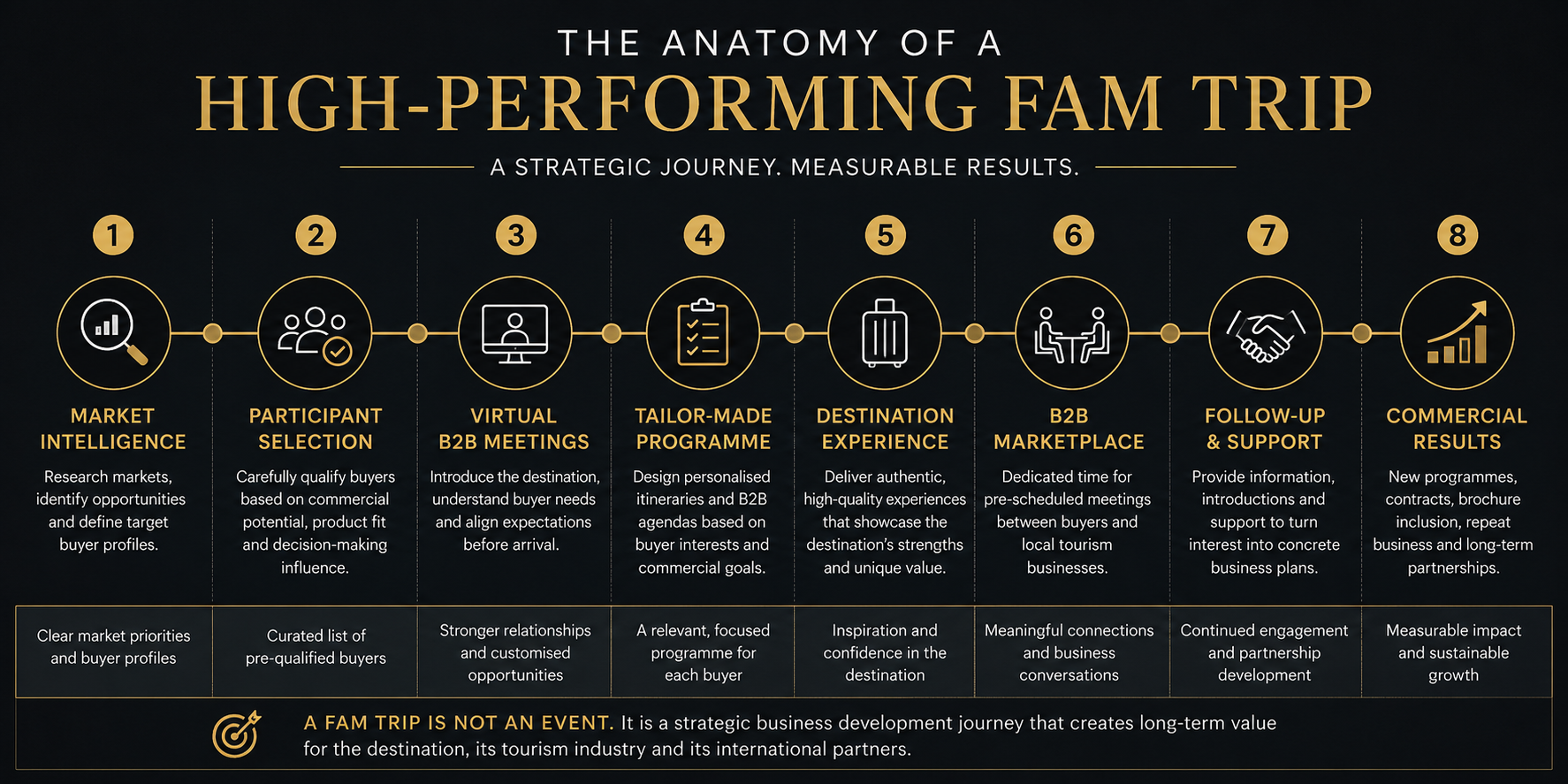
The destinations that consistently achieve the strongest commercial results approach familiarisation trips very differently. Rather than treating them as standalone hospitality initiatives, they design them as integrated business development programmes that begin months before participants arrive and continue long after they return home.
Every stage of the process is aligned with one fundamental objective: creating measurable business opportunities for both the destination and its tourism industry.
1. Smaller Groups. Greater Impact.
One of the biggest misconceptions in destination marketing is that larger FAM trips automatically generate greater exposure. While a larger group may create more photographs, more social media posts and a busier programme, it rarely creates stronger commercial relationships.
Successful destinations increasingly favour smaller, highly curated groups of carefully selected participants.
A group of eight to twelve buyers, each with genuine commercial potential, allows for meaningful conversations, personalised experiences and direct interaction with local tourism businesses. Participants have more opportunities to ask questions, explore products relevant to their markets and build genuine relationships with the people they may ultimately do business with.
For local suppliers, smaller groups also create a far more productive environment. Instead of presenting to dozens of visitors at once, they can engage in focused discussions with buyers who are genuinely interested in their products and services.
Quality consistently delivers greater long-term value than quantity.
2. Careful Selection Before the Invitation Is Sent
The invitation itself should be the final step of the selection process—not the first.
Every participant should be assessed against clear commercial criteria before receiving an invitation.
Questions destinations should ask include:
- Does this buyer actively sell products that match our destination?
- Does their client profile align with our target markets?
- Do they have decision-making authority?
- Are they actively seeking new destinations?
- What commercial opportunities could realistically emerge from this partnership?
This approach transforms participant selection from a hospitality exercise into a strategic investment decision.
Every seat on a FAM trip represents an investment. Every participant should therefore represent a genuine business opportunity.
3. The FAM Trip Starts Months Before Arrival
One of the biggest differences between traditional and high-performing FAM programmes is that successful destinations understand the trip does not begin at the airport.
It begins months earlier.
Pre-trip preparation allows destinations to understand each participant’s business model, commercial priorities and specific interests. Rather than waiting until arrival to introduce the destination, organisers can begin building relationships through virtual meetings, destination presentations and individual discussions.
These early conversations help identify opportunities that can later be explored in greater depth during the visit itself.
By the time participants arrive, they should already understand why the destination is relevant to their business.
The visit then becomes an opportunity to confirm commercial potential—not simply discover it.
4. Combine Virtual and Physical B2B Meetings
One of the most valuable additions to a modern FAM programme is the integration of structured business meetings before and during the visit.
Virtual B2B meetings held several weeks before arrival provide an opportunity for destinations to introduce local tourism products, understand buyer expectations and identify specific partnership opportunities. They also help determine which local suppliers should meet each participant during the visit.
Once participants arrive, these conversations should continue through a dedicated B2B Marketplace.
Rather than expecting commercial relationships to develop naturally during sightseeing or dinner conversations, destinations should dedicate at least half a day—and ideally a full day—to pre-scheduled business appointments.
Each meeting should be carefully matched according to commercial interests, market focus and product compatibility.
This creates significant value for both international buyers and local tourism businesses. Buyers leave with concrete business contacts rather than general impressions, while local suppliers gain direct access to carefully selected international partners who are genuinely interested in developing new products.
The destination becomes more than a host.
It becomes a facilitator of international business.
5. Design Tailor-Made Itineraries
Not every participant should experience the same destination in exactly the same way.
A luxury travel specialist, an adventure tour operator and a cultural travel advisor are unlikely to develop identical products after returning home.
Their itineraries should therefore reflect their commercial interests.
While some shared experiences are valuable for networking and destination storytelling, individual site visits, optional experiences and targeted supplier meetings allow participants to explore the products most relevant to their clients.
Personalisation demonstrates professionalism.
More importantly, it increases the likelihood that participants will return home with practical ideas they can immediately incorporate into their own travel programmes.
6. Follow-Up Is Where Business Begins
For many destinations, the final dinner unintentionally becomes the conclusion of the relationship.
In reality, it should be the beginning.
The weeks immediately following a FAM trip are often the most important period of the entire programme. Participants return to busy offices, evaluate new opportunities and begin planning future products. Destinations that maintain regular communication during this period remain part of those discussions.
Effective follow-up includes sharing requested information promptly, facilitating additional introductions between buyers and local businesses, supporting itinerary development, providing marketing materials and scheduling further online meetings where appropriate.
Commercial relationships are rarely built during a four-day visit alone.
They are built through consistent communication over the months that follow.
Measuring Success
If You Can’t Measure It, You Can’t Improve It
Perhaps the biggest shift destinations need to make is not in how they organise FAM trips, but in how they evaluate them.
For many organisations, success is still measured by participant satisfaction. If guests compliment the accommodation, praise the programme or leave enthusiastic comments at the farewell dinner, the trip is often considered a success.
While positive feedback certainly matters, it should never be the primary performance indicator.
A FAM trip is a strategic investment in international market development. Like any business investment, it should be evaluated against measurable commercial outcomes that demonstrate long-term value for the destination.
The most successful destinations therefore replace subjective impressions with clear Key Performance Indicators (KPIs) that can be monitored over time. These indicators help determine not only whether the programme was enjoyable, but whether it generated meaningful business opportunities and measurable return on investment.
Instead of asking:
“Did everyone enjoy the trip?”
Destination leaders should be asking questions such as:
- How many new tourism programmes or packages were developed?
- How many new itineraries included the destination?
- How many brochure or website inclusions were secured?
- How many commercial agreements or partnerships emerged?
- How many follow-up meetings took place after the visit?
- How many participating buyers continued engaging with local suppliers?
- What estimated visitor value could these new partnerships generate over the next three to five years?
These are the metrics that transform a FAM trip from a hospitality expense into a strategic business investment.
Because ultimately, the objective is not to organise memorable visits.
The objective is to create measurable market growth.
CASE STUDY When Quality Replaced Quantity
One regional destination decided to fundamentally rethink the way it organised its annual familiarisation programme. Rather than increasing the number of invited participants, the destination chose to reduce the group size while significantly strengthening the qualification process. Every invited buyer was carefully selected based on commercial relevance, market potential and alignment with the destination's strategic objectives. Several months before arrival, participants joined a series of virtual B2B meetings designed to introduce the destination, understand buyer priorities and identify genuine business opportunities. These early conversations allowed both the destination and participating buyers to arrive with clear commercial objectives already established. During the hosted visit, the programme included a dedicated B2B Marketplace, where carefully matched local tourism businesses met international buyers through pre-scheduled one-to-one appointments. Rather than relying solely on informal networking during sightseeing or social events, the destination created structured opportunities for meaningful business discussions. The destination experience itself remained authentic, carefully curated and highly personalised, but every activity supported a broader commercial purpose. The outcome was clear. Despite welcoming fewer participants than in previous years, the programme generated stronger buyer engagement, more product development discussions, a higher number of follow-up meetings and significantly greater commercial opportunities for local tourism businesses. The destination discovered that success was not determined by the number of participants attending the programme, but by the quality of the relationships it helped create. Sometimes, inviting fewer people is the most effective way to generate more business.
Addendum
Share this article
Planning a FAM Trip for 2027?
Before sending invitations, make sure your next familiarisation programme is designed to generate measurable business results—not simply memorable experiences.
During this complimentary 30-minute strategy session, we'll discuss your target markets, participant selection, commercial objectives, B2B matchmaking opportunities and practical ways to maximise the return on your investment.
- ✔ Review your current FAM trip approach
- ✔ Identify opportunities to improve buyer qualification
- ✔ Discuss virtual & physical B2B marketplace integration
- ✔ Explore KPIs that measure real commercial impact
- ✔ Receive practical recommendations tailored to your destination
No obligation. Just a strategic conversation focused on helping your destination create stronger international partnerships and long-term tourism growth.