
How Christopher Nolan’s The Odyssey Is Transforming the Peloponnese into a Global Film Tourism Destination
Christopher Nolan’s The Odyssey Filming Locations in the Peloponnese
July 18, 2026 • 10 min read • By Addendum
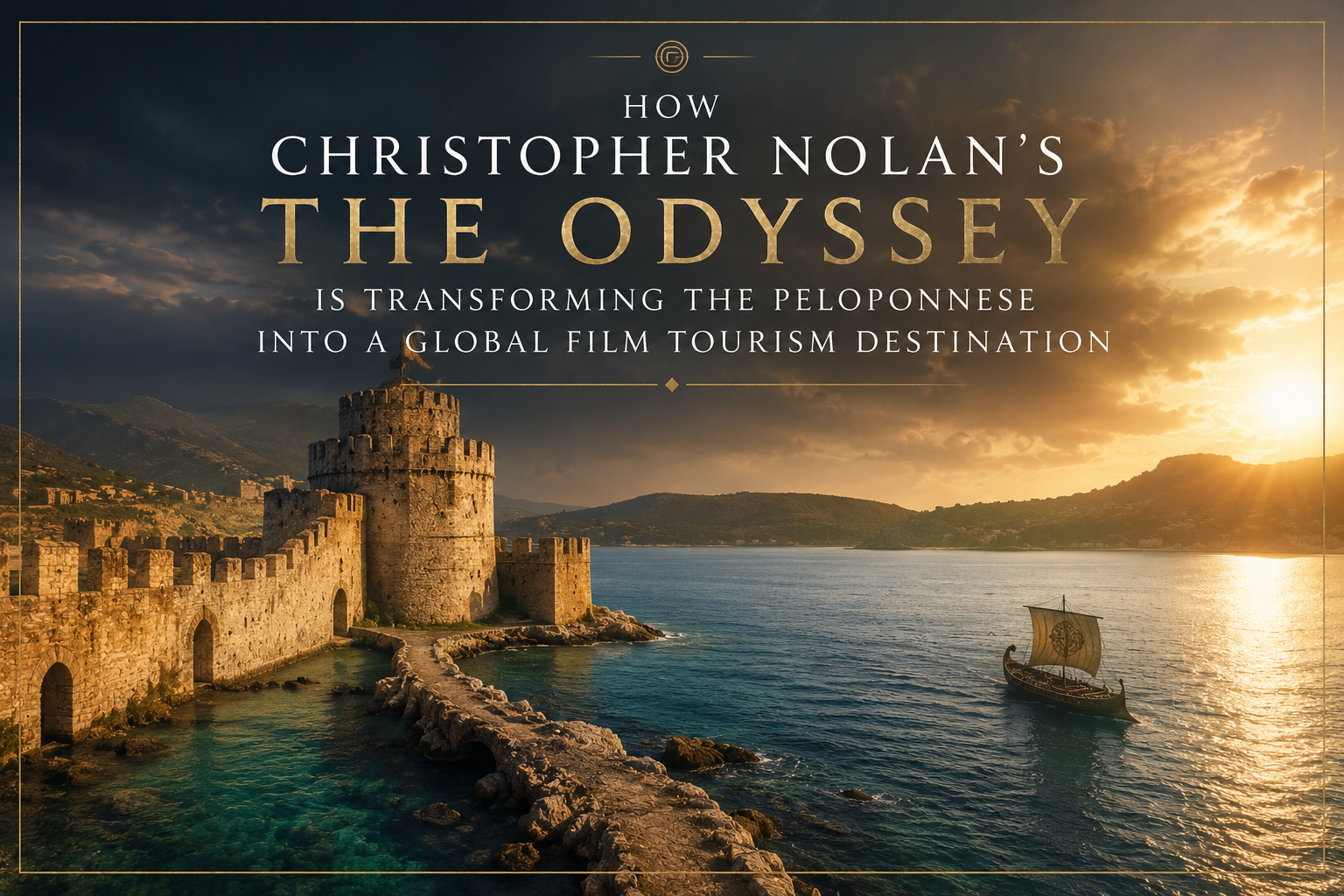
Christopher Nolan’s The Odyssey has placed the Peloponnese at the centre of an extraordinary wave of global attention.
The highly anticipated adaptation of Homer’s epic was filmed across several countries, but some of its most striking locations are found in the Greek region whose landscapes, castles and archaeological sites already carry deep connections to myth and history.
From the monumental fortress of Acrocorinth to Methoni Castle, Voidokilia Beach, Almyrolaka and Nestor’s Cave, the Peloponnese is no longer appearing only as a cinematic backdrop. It is emerging as a destination that international media, travel companies and potential visitors are actively being encouraged to explore.
The global conversation surrounding the film demonstrates the growing power of film tourism, also known as screen tourism or set-jetting: the practice of travelling to places seen in films and television productions.
For the Peloponnese, however, the opportunity extends far beyond visiting a film set.
The real strategic value lies in connecting cinema with mythology, archaeology, cultural heritage, nature, gastronomy and contemporary travel experiences—and turning worldwide visibility into long-term destination value.
Where Was Christopher Nolan’s The Odyssey Filmed in the Peloponnese?
The Hellenic Film Commission officially identified five principal filming locations in the Peloponnese:
Nestor’s Cave & Nestor’s Palace
Voidokilia Beach
Almyrolaka Beach
Methoni Castle
Acrocorinth
Filming in Greece took place during March and April 2025, following cooperation between the Hellenic Film & Audiovisual Center, Universal Pictures and Syncopy.
The production was supported under strict preservation requirements, reflecting the importance of protecting the archaeological and natural character of the locations involved.
These were not generic landscapes selected merely for their visual beauty. Each location contributes something distinct to the cinematic and tourism narrative of the Peloponnese.
Acrocorinth: A Monumental Gateway to the Homeric World
Rising above Ancient Corinth, Acrocorinth is one of Greece’s most imposing fortified sites.
Its scale, strategic position and panoramic views made it a natural choice for a film seeking to recreate a world of kingdoms, warriors and epic journeys.
For travellers, Acrocorinth offers considerably more than a connection to Nolan’s production. It opens the way to Ancient Corinth, the Corinthian landscape and the wider northeastern Peloponnese.
Its proximity to Athens also gives it an important advantage as a potential entry point for a wider Odyssey-inspired route through the region.
Visitors can combine the fortress with the Archaeological Site of Ancient Corinth, creating an experience that connects cinematic recognition with authentic archaeological discovery.
A short distance from Acrocorinth, visitors can also explore the Baths of Helen of Troy (Loutra Oreas Elenis), a coastal area associated with one of the most enduring figures of the Homeric mythology. According to legend, Helen would visit this spot to bathe in its cold, crystal-clear spring waters, believed to have therapeutic and rejuvenating properties. Today, the location offers a unique blend of myth, nature and relaxation, allowing travellers to connect the cinematic and archaeological experience of the region with a living mythological landscape just a short drive away.
Methoni Castle: History on a Cinematic Scale
Methoni Castle is one of the most impressive fortified monuments in the Peloponnese.
Extending across a vast archaeological site and connected to the distinctive Bourtzi tower by a stone causeway, the castle already possesses the dramatic scale expected of an international film production.
Its appearance in The Odyssey gives Methoni an opportunity to reach travellers who may previously have associated Greece mainly with Athens and the islands.
The destination can now be presented through several complementary narratives:
Christopher Nolan’s filming locations
Medieval and Venetian heritage
Coastal travel
Mediterranean history
Road trips through southern Messinia
Cultural and experiential tourism
This combination is particularly important. Film tourism is strongest when the screen connection becomes an invitation to discover the wider identity of a place rather than the sole reason to visit it.
Voidokilia Beach and Nestor’s Cave: Where Landscape Meets Myth
Few landscapes express the cinematic potential of the Peloponnese as powerfully as Voidokilia.
Its near-perfect semicircular bay has long been one of the most recognisable natural landmarks in Messinia. Above it lies Nestor’s Cave, a place associated with King Nestor and the Homeric tradition.
Reports surrounding the production have connected the cave with the Cyclops sequences, further strengthening the relationship between the physical landscape and the mythological world recreated on screen.
The importance of this area extends well beyond its visual appeal.
Within a relatively concentrated territory, visitors can experience:
Voidokilia Beach
Nestor’s Cave
the Gialova Lagoon
Pylos and Navarino Bay
the Palace of Nestor
Methoni Castle
local gastronomy and olive oil culture
luxury and sustainable hospitality
This creates the foundation for a complete travel experience rather than an isolated photo stop.
From Filming Location to International Travel Story
The most immediate impact of The Odyssey has been the scale of international media attention generated for the Peloponnese.
Major global publications are not merely mentioning the region as a production location. They are actively presenting its landscapes as places readers should visit.
Vogue described the film’s locations as an “epic travel guide”, highlighting Voidokilia, Methoni Castle, Acrocorinth, Almyrolaka and Nestor’s Cave among the Greek sites associated with the production.
Forbes explored how travellers can turn the film’s Peloponnese locations into a real Greek journey, moving the conversation directly from cinema toward bookable experiences.
The Times created an itinerary inspired by the footsteps of Homer’s Odyssey, while another Times feature identified Messinia as an emerging Greek destination supported by the combined momentum of the film and improved air connectivity.
The Telegraph presented Messinia as the real star of the film, further reinforcing its appeal as a distinctive travel destination.
Expedia published a guide to the film’s real-world locations, placing Acrocorinth and the Peloponnese within a major international travel-planning platform.
Other international travel publications have followed:
Travel Weekly: A set-jetting guide to Greece inspired by The Odyssey
Elite Traveler: How The Odyssey is putting Messinia on the global map
Newmarket Holidays: How travellers can visit the real locations
The significance of this coverage should not be underestimated.
Editorial exposure in influential international media creates awareness, but articles that include itineraries, accommodation suggestions and practical travel advice go one step further: they begin converting cinematic interest into travel intention.
Why The Odyssey Is Especially Powerful for the Peloponnese
Not every production creates the same tourism opportunity.
The connection between The Odyssey and the Peloponnese is particularly powerful because the destination does not need to manufacture a new identity around the film.
The underlying story already belongs to the cultural world of the region.
The Peloponnese is connected with:
the kingdoms of Mycenae, Sparta and Pylos
Agamemnon, Menelaus and Nestor
the Trojan War
Homeric memory
ancient routes and fortresses
Mediterranean seafaring
landscapes that still evoke the scale of epic storytelling
The production therefore reinforces an identity that is historically and culturally authentic.
Visitors attracted by the film can encounter not a temporary movie set, but archaeological sites, landscapes and communities that deepen their understanding of the story.
That gives the Peloponnese a stronger foundation for lasting film tourism than destinations whose connection to a production is purely visual.
The Rise of Set-Jetting
Set-jetting has become a significant influence on international travel decisions.
Films and television series allow destinations to reach global audiences at a scale that conventional destination advertising often cannot match. They create emotional familiarity before a traveller has ever arrived.
A location seen on screen can become:
a source of travel inspiration
a recognisable visual symbol
part of a themed itinerary
a social-media destination
a reason to extend a trip
a gateway to lesser-known regions
The opportunity is particularly valuable for destinations seeking to move travellers beyond established tourism centres.
In the case of Greece, The Odyssey can help direct international attention away from an exclusively island-based image of the country and toward the mainland, the Peloponnese and its diverse year-round experiences.
International Visibility Is Only the Beginning
A major production can generate enormous awareness, but visibility alone does not automatically produce long-term tourism growth.
The destinations that benefit most from film tourism are usually those that actively convert screen exposure into a structured visitor proposition.
That requires several elements.
1. A Clearly Defined Odyssey Route
The principal filming locations should be connected through a coherent itinerary rather than promoted as unrelated points.
A potential route could connect:
Acrocorinth and Ancient Corinth
Pylos and Navarino Bay
the Palace of Nestor
Voidokilia and Nestor’s Cave
Gialova
Methoni Castle
The route should include realistic travel times, suggested stays and complementary experiences.
2. Strong Digital Content
Potential visitors searching for The Odyssey filming locations should find authoritative and practical destination information.
This content should answer questions such as:
Where was The Odyssey filmed in Greece?
Which scenes were filmed in the Peloponnese?
Can visitors access the locations?
How can travellers reach them?
How many days are needed?
What else can they experience nearby?
Which locations are protected or subject to access restrictions?
The official Visit Peloponnese website can play a central role in connecting global search interest with reliable destination information.
3. Bookable Experiences
The strongest film tourism products move beyond sightseeing.
Possible experiences could include:
guided archaeological journeys
mythology-focused tours
hiking routes around Voidokilia and Navarino
cinematic photography tours
storytelling experiences
Homeric gastronomy
sailing itineraries
educational programmes
family-oriented mythology activities
multi-day Peloponnese road trips
4. Travel Trade Partnerships
International tour operators, travel advisors and specialist cultural operators should be provided with practical itineraries and destination material.
Film-related demand can then be incorporated into:
cultural tours
luxury programmes
educational travel
active tourism
family holidays
cruise extensions
European touring itineraries
5. Continued International Media Engagement
The current media attention provides an excellent foundation, but it should be sustained through targeted press trips, storytelling and new experiences.
Visit Peloponnese has already begun connecting The Odyssey with wider destination promotion. During a 2026 familiarisation trip organised with the Greek National Tourism Organisation, international media representatives visited the Palace of Nestor and the wider Navarino area as part of a programme highlighting the Peloponnese’s cultural and experiential tourism offering.
Read more about the Visit Peloponnese and GNTO familiarisation trip.
The Opportunity Extends Beyond Messinia
Messinia has received much of the international attention because several filming locations are concentrated around Pylos, Voidokilia and Methoni.
However, the inclusion of Acrocorinth gives the story a wider regional dimension.
This creates an opportunity to position The Odyssey not only as a Messinian experience, but as a journey through the Peloponnese.
Such an approach can encourage:
longer stays
travel across more than one regional unit
greater visitor dispersal
stronger links between cultural and natural attractions
increased benefits for smaller communities and local businesses
This is one of the most important strategic possibilities created by the production.
The goal should not simply be to attract more visitors to one famous beach or castle. It should be to use the film as an entry point into the wider diversity of the Peloponnese.
Measuring the Real Tourism Impact
The scale of the media response already demonstrates a major gain in international visibility.
However, the long-term tourism effect should be measured carefully rather than assumed.
Relevant indicators could include:
searches for Peloponnese filming locations
organic traffic to related destination pages
international media mentions
social-media engagement
tour operator enquiries
new film-inspired itineraries
visitor numbers at accessible filming locations
length of stay in surrounding areas
geographic distribution of visitors
accommodation performance
visitor spending
awareness of the Peloponnese in target markets
This is where destination intelligence becomes important.
Film tourism should not be evaluated only through press clippings or social-media reach. Destinations need to understand whether global attention results in actual travel demand, stronger destination awareness and measurable benefits for the local visitor economy.
From Global Production to Long-Term Destination Value
Christopher Nolan’s The Odyssey has already achieved something rare for the Peloponnese.
It has brought together one of the world’s most influential filmmakers, one of literature’s most enduring stories and some of Greece’s most powerful landscapes.
International media have responded by presenting the region not merely as a film location, but as a destination travellers should experience for themselves.
That represents an exceptional opportunity.
But the greatest value will not come from the film’s release alone.
It will come from what happens next: the development of routes, content, experiences, partnerships and measurable destination strategies that allow the Peloponnese to convert cinematic attention into sustainable tourism growth.
The production may have introduced millions of viewers to the landscape.
The next task is to give them a compelling reason to begin their own Peloponnesian odyssey.
Share this article
Planning Your Own Odyssey?
Christopher Nolan’s The Odyssey has introduced millions of people to the extraordinary landscapes of the Peloponnese—but the real journey begins when you experience them in person.
From the imposing fortress of Acrocorinth to the legendary Nestor’s Cave, the medieval walls of Methoni Castle and the breathtaking shores of Voidokilia, the Peloponnese offers an exceptional combination of mythology, history and natural beauty.
Discover travel inspiration, experiences and practical information on the official destination website.
Explore the Peloponnese →Turning Global Attention into Long-Term Tourism Growth
Major films generate headlines. Successful destinations create lasting economic value.
International productions can become powerful catalysts for tourism, but only when supported by long-term strategy, destination storytelling, market development and international partnerships.
Addendum works with destinations, DMOs, CVBs and tourism organizations to transform opportunities created by film productions, major sporting events and cultural initiatives into sustainable tourism growth and measurable results.