In this article
European Market Opportunity
Why Europe Still Matters
The Traditional Model Is No Longer Sustainable
A Smarter Alternative: European Market Representation
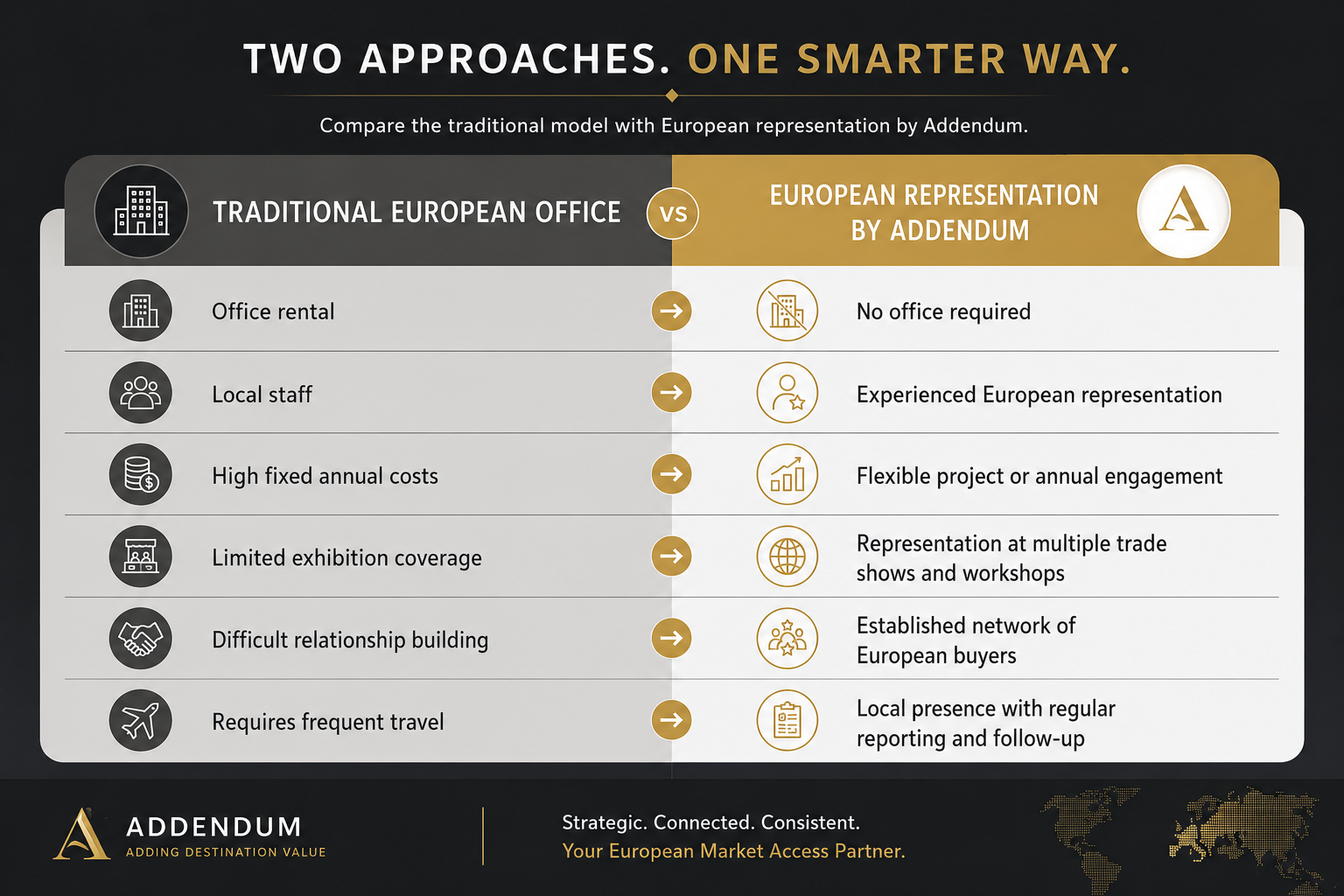
European Office vs. European Representation
Building Market Presence
Trade Show Representation
Year-Round European Presence
Virtual Sales Missions
FAM Trips That Generate Business
Developing a Dedicated European Strategy
Market Development
Adapting Your Message by Market
Building Trade Partnerships
Measuring Results Beyond Arrivals
Why Consistency Matters
For an even more executive-style sidebar, I would use this shorter version:
European Market Access
Why Europe Matters
A Smarter Representation Model
Office vs. Agency Representation
Practical Actions
Trade Shows
Year-Round Representation
Virtual Sales Missions
Business-Focused FAM Trips
Market Strategy
Long-Term Results
Market-Specific Messaging
Trade Partnerships
Measuring ROI
Consistency in Europe
Related services
• Trade Representation & B2B Growth
• Partnership Development
Let’s talk strategy
“California destinations do not need a permanent European office to build a strong European presence. They need the right strategy, consistent representation and relationships that continue long after the trade show ends.”
— Addendum
How California Destinations Can Grow European Tourism Without Opening a European Office
July 15, 2026 • 8 min read • By Addendum
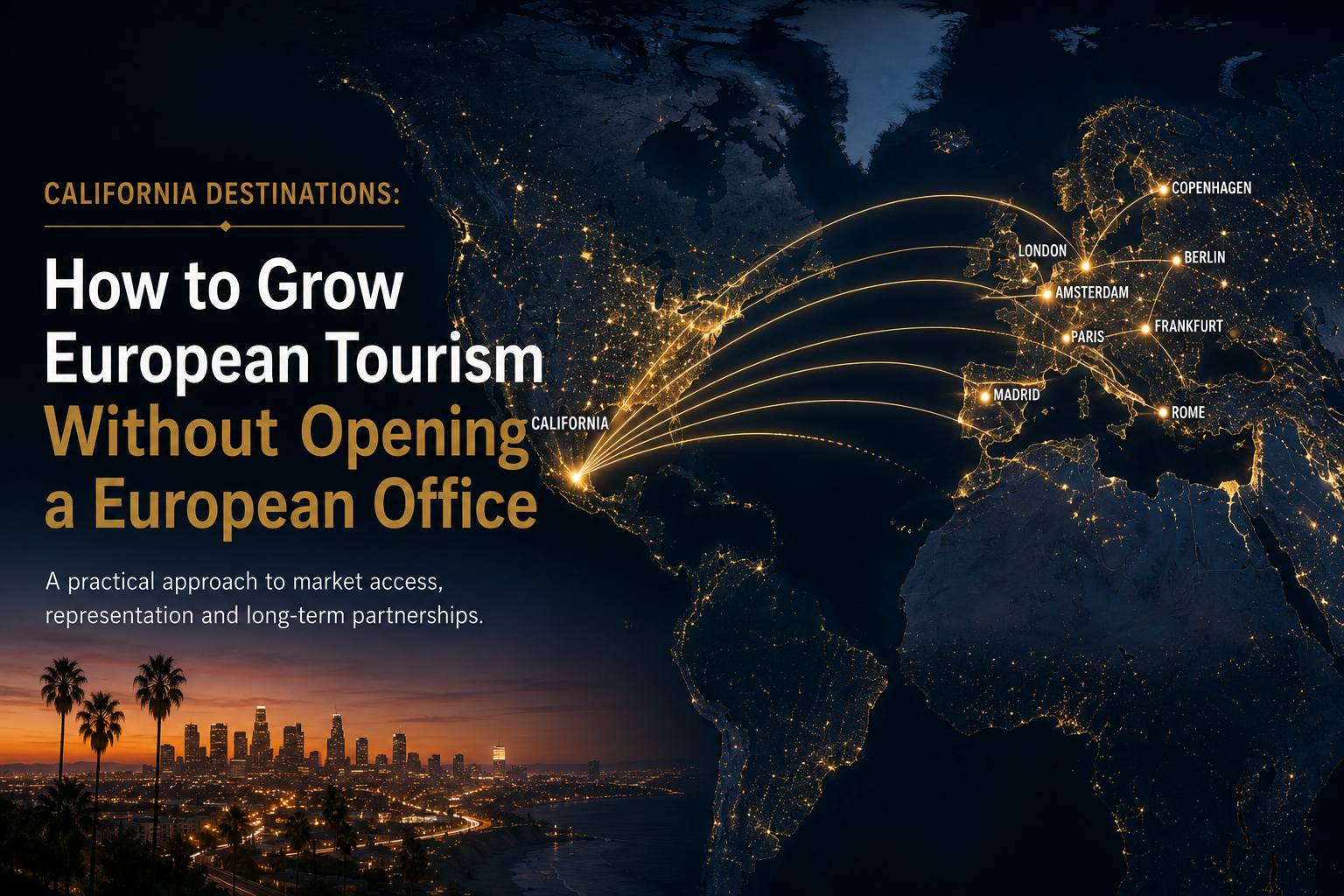
European market access is no longer reserved for destinations with million-dollar marketing budgets. With the right strategy and the right representation, California destinations of every size can build meaningful relationships across Europe—without establishing an overseas office.
Europe Remains One of California’s Most Valuable International Markets
California has long been one of the world’s most desirable travel destinations. From iconic cities and national parks to wine regions, coastal escapes and outdoor adventures, it offers an extraordinary diversity of experiences that appeal strongly to European travellers.
Yet while destinations such as Los Angeles, San Francisco and San Diego enjoy global recognition, many other California destinations remain underrepresented in the European travel trade.
The challenge is rarely the quality of the destination.
The challenge is visibility, consistency and market access.
European tour operators, travel advisors and wholesalers cannot recommend destinations they rarely hear from. Even the most attractive destination can struggle to generate business if it only appears in Europe once a year—or not at all.
Fortunately, building a strong European presence no longer requires opening a permanent office overseas. Today, there are smarter, more flexible ways to connect with the European market while making far better use of marketing budgets.
Why Europe Should Remain a Strategic Priority
For many California destinations, Europe represents one of the most valuable long-haul visitor markets.
European travellers typically:
- Stay longer than domestic visitors.
- Spend more per trip.
- Travel beyond gateway cities.
- Explore multiple destinations during one journey.
- Travel throughout the shoulder seasons.
- Seek authentic cultural, culinary and outdoor experiences.
Unlike many short-haul visitors, Europeans often plan holidays lasting two or even three weeks. This creates opportunities for regional destinations, scenic byways, wine regions, coastal communities and smaller cities to become part of a broader California itinerary.
For destinations looking to diversify visitation, reduce seasonality and attract higher-value travellers, Europe should remain a long-term strategic priority—not simply an occasional marketing initiative.
The Traditional Model Is No Longer Sustainable
For decades, international tourism development followed a familiar formula.
Open a representative office.
Employ local staff.
Attend several trade shows every year.
Travel regularly to Europe.
Maintain ongoing sales activity.
While this approach can work for very large destinations, it requires substantial financial resources and long-term commitments.
For most regional destinations, counties, cities and CVBs, maintaining a permanent European office is simply unrealistic.
Even participating in multiple trade shows each year can quickly consume a significant portion of an international marketing budget once flights, accommodation, exhibition costs and staff time are considered.
The result?
Many destinations appear in Europe once, collect a stack of business cards and then disappear for another twelve months.
Unfortunately, international tourism rarely works that way.
Relationships require consistency.
A Smarter Alternative: European Market Representation
Instead of investing in permanent overseas offices, many destinations are now choosing a more flexible approach: partnering with specialised European representation agencies.
Rather than building infrastructure from scratch, destinations gain immediate access to professionals who already work within the European travel trade and maintain relationships with:
- Tour operators
- Wholesalers
- Travel advisors
- Destination specialists
- MICE buyers
- Travel media
- Industry associations
- Trade event organisers
This allows destinations to maintain an active presence throughout Europe while avoiding the fixed costs associated with operating overseas.
More importantly, it allows local destination teams to remain focused on product development and visitor experience while trusted representatives manage business development in-market.
Five Practical Ways California Destinations Can Strengthen Their European Presence
1. Participate in European Trade Shows Without Sending a Large Team
International trade shows remain one of the most effective places to meet qualified buyers.
Events such as ITB Berlin, WTM London, FITUR Madrid, IFTM Top Resa Paris and numerous specialised workshops continue to generate valuable business opportunities.
However, successful participation requires far more than simply having a booth.
Appointments need to be scheduled in advance.
Buyers must be carefully selected.
Meetings require preparation.
Follow-up is essential.
Many destinations are now choosing to be professionally represented at selected trade shows through trusted European partners rather than sending multiple staff members across the Atlantic several times each year.
Representation can include:
- Pre-scheduled B2B appointments
- Destination presentations
- Lead collection
- Buyer qualification
- Meeting reports
- Post-event follow-up
This approach significantly reduces travel costs while ensuring that destinations remain present where important business conversations are taking place.
2. Build Relationships Throughout the Year—Not Just During Trade Shows
Perhaps the biggest misconception in international tourism marketing is that trade shows create business.
They don’t.
Relationships create business.
Trade shows simply provide opportunities to begin or strengthen those relationships.
European tour operators work months—sometimes years—in advance when designing new itineraries. They need regular updates about destinations, accommodation developments, new experiences, air connectivity and seasonal opportunities.
If a destination disappears after one exhibition, it quickly disappears from buyers’ planning as well.
Successful destinations remain visible all year.
Consistent communication may include:
- Quarterly destination updates
- New product announcements
- Seasonal travel ideas
- Educational newsletters
- Trade media outreach
- Virtual meetings
- Market updates
Consistency builds familiarity.
Familiarity builds confidence.
Confidence leads to inclusion in future travel programmes.
3. Bring Europe to Your Office Through Virtual Sales Missions
Technology has fundamentally changed how destinations can engage international markets.
There is no longer a need to wait for the next trade show to speak with European buyers.
Virtual trade presentations and online sales missions allow destinations to connect directly with carefully selected audiences across multiple European countries without leaving California.
These sessions may include:
- Destination webinars
- Product launches
- Supplier presentations
- Market briefings
- Educational workshops
- Buyer networking sessions
- Question-and-answer discussions
Rather than presenting to hundreds of unknown participants, successful virtual events focus on carefully invited professionals with genuine interest in the destination.
This approach is more targeted, more cost-effective and can be repeated several times throughout the year.
4. Organise FAM Trips That Generate Business—Not Just Beautiful Photos
Educational visits remain one of the most powerful tourism marketing tools available.
When designed correctly.
Too many familiarisation trips focus primarily on hospitality, sightseeing and entertainment while overlooking the commercial objectives behind the investment.
Successful FAM trips begin long before participants arrive.
The most effective programmes:
- Invite carefully selected buyers whose markets match the destination.
- Set clear business objectives before arrival.
- Include opportunities for local suppliers to meet participants.
- Present experiences relevant to future itineraries.
- Collect measurable outcomes.
- Maintain structured follow-up after the visit.
Smaller, highly targeted groups often produce significantly stronger commercial results than large, expensive educational visits.
The objective should never be to impress participants.
The objective should be to create future business.
5. Build Your European Strategy Before Spending Your Budget
Many destinations begin international planning by asking:
“Which trade show should we attend?”
The better question is:
“What are we trying to achieve in Europe?”
Every destination is different.
Every destination has different strengths.
Every destination appeals to different markets.
Before investing in exhibitions, campaigns or trade missions, destinations should develop a clear international strategy that answers questions such as:
- Which European markets offer the greatest opportunity?
- Which visitor segments fit our destination?
- Which products should be prioritised?
- Which partners should we target?
- Which exhibitions actually match our objectives?
- How should success be measured?
A well-defined strategy prevents fragmented marketing activities and ensures that every investment contributes toward long-term objectives rather than isolated promotional efforts.
One Message Does Not Fit Every European Market
Europe is not a single market.
It is a collection of countries with different travel habits, cultural preferences and purchasing behaviour.
What attracts German travellers may differ significantly from what appeals to visitors from France, the United Kingdom or the Netherlands.
For example:
Germany
Outdoor recreation, hiking, cycling, nature and sustainability.
France
Culture, gastronomy, wine, heritage and authentic local experiences.
United Kingdom
Road trips, coastal escapes, family travel, golf and luxury accommodation.
Netherlands
Cycling routes, camping, outdoor activities and nature-based tourism.
The most successful destinations adapt their messaging instead of promoting the same experiences to every market.
Local knowledge makes a measurable difference.
Partnerships Often Deliver More Than Advertising
Advertising creates awareness.
Partnerships create bookings.
Long-term cooperation with European tour operators, travel advisors, wholesalers and destination specialists often generates far greater return than isolated advertising campaigns.
When travel professionals understand a destination, they recommend it repeatedly to their clients year after year.
That creates sustainable business growth.
Rather than focusing exclusively on consumer campaigns, successful destinations invest in developing trusted relationships across the travel trade.
Those relationships become one of the destination’s most valuable international assets.
Measure Success Beyond Visitor Numbers
International tourism development should never be measured solely by arrivals.
Meaningful indicators include:
- Qualified buyer meetings.
- New commercial partnerships.
- Destination inclusion in European itineraries.
- Tour operator programmes developed.
- Educational presentations delivered.
- Media relationships established.
- Repeat meetings with key partners.
- Growth in trade enquiries.
These indicators reveal whether long-term market development is actually taking place.
Visitor growth follows relationship growth—not the other way around.
Europe Rewards Consistency, Not Visibility Alone
European tourism is not built during a three-day trade show.
It is built through continuous engagement, meaningful relationships and consistent market presence.
Destinations that communicate regularly, understand individual European markets and maintain ongoing contact with the travel trade become familiar, trusted and ultimately bookable.
For California destinations, expanding into Europe no longer requires the cost and complexity of opening a permanent overseas office.
With the right strategy, carefully selected market priorities and experienced representation on the ground, destinations can establish a professional year-round presence, strengthen commercial partnerships and attract higher-value European visitors more efficiently than ever before.
The opportunity is there.
The question is no longer whether California destinations can succeed in Europe.
It is whether they are prepared to approach the market strategically, consistently and with the long-term perspective that international tourism demands.
Ready to Expand Your Destination's Presence in Europe?
Whether you're planning your first European trade engagement or looking to improve the return on your international tourism investment, Addendum helps destinations develop practical, relationship-driven market access strategies tailored to your goals.
Book Your Free European Market Access AssessmentDiscover how your destination can strengthen its presence across Europe—without the cost of opening a European office.