The Ultimate Guide to Building an Annual Tourism Strategy for 2027
July 10, 2026 • 25 min read • By Addendum
Executive Introduction: Why 2026 Changed Everything
There are years that simply add another chapter to the tourism industry’s history, and there are years that fundamentally redefine how destinations must think, plan and compete.
For many Destination Management Organizations (DMOs), Regional Tourism Organizations (RTOs), Convention & Visitors Bureaus (CVBs) and tourism authorities around the world, 2026 will be remembered as one of those defining years.
While international travel continued its recovery and global demand remained strong across many markets, the operating environment became considerably more complex than many destinations had anticipated. Geopolitical instability influenced traveller confidence, inflation continued to affect travel spending, airline networks evolved in response to changing demand, and climate-related events increasingly disrupted both visitor flows and destination operations. At the same time, artificial intelligence began reshaping the way travellers discover, compare and book destinations, while consumer expectations shifted further towards authentic, sustainable and experience-driven travel.
Individually, none of these developments was entirely unexpected. Together, however, they created an environment in which yesterday’s assumptions no longer guaranteed tomorrow’s success.
For destinations, the lesson was clear: the tourism landscape is no longer changing every few years—it is changing continuously.
In this environment, relying on annual routines is becoming increasingly risky. Strategies based primarily on historical performance, fixed marketing calendars or recurring activities are often unable to respond to the speed at which markets now evolve. What worked successfully three years ago may no longer deliver the same results today, and activities that once generated significant value may now compete with entirely new opportunities for investment.
This shift requires a different way of thinking.
The most successful destinations are no longer those that simply promote themselves more aggressively or invest the largest marketing budgets. Increasingly, they are the destinations that make better strategic decisions. They understand their markets more deeply, allocate resources more intelligently, build stronger international partnerships and remain agile enough to adapt when circumstances change.
Perhaps most importantly, they recognise that an Annual Tourism Strategy is not simply a marketing document prepared at the beginning of the year. It is a decision-making framework that aligns vision, investment, partnerships, destination development and measurable objectives into a single, coordinated plan.
Unfortunately, many destinations continue to approach strategic planning as an administrative exercise rather than a competitive advantage. Budgets are often discussed before priorities have been defined. Trade exhibitions are renewed because they have always been attended. Press trips, FAM trips and marketing campaigns are planned independently, each with its own objectives and budget, but without being connected through a broader strategic vision. The result is not necessarily poor marketing—it is fragmented investment.
When activities are planned in isolation, even well-executed initiatives struggle to achieve their full potential. A successful press trip may generate excellent media coverage, but if it is not aligned with priority source markets or supported by travel trade development, its long-term commercial value may remain limited. Likewise, participation in international trade shows can create valuable exposure, but without targeted follow-up, strategic partnerships and clear market objectives, those opportunities often fail to translate into sustainable visitor growth.
The challenge facing destinations today is therefore not simply deciding what to do next.
It is deciding why they are doing it, who they are trying to reach, which activities genuinely support their long-term objectives, and how every investment contributes to measurable outcomes.
This is why planning for 2027 should begin now.
Not because the calendar demands it, but because today’s tourism environment demands a higher level of strategic thinking than ever before. The months leading up to the new year provide destinations with a valuable opportunity to reassess market priorities, evaluate existing investments, strengthen partnerships, identify emerging trends and build an integrated strategy before budgets are committed and opportunities begin to disappear.
The destinations that will lead in 2027 will not necessarily be those with the largest marketing budgets.
They will be the ones that make the best strategic decisions long before the new year begins.
This guide has been developed to help destination leaders do exactly that. Drawing on international market experience, destination strategy, travel trade development and tourism marketing best practices, it outlines the key components of an effective Annual Tourism Strategy and explores how destinations can transform individual marketing activities into a coordinated framework for sustainable growth.
Because successful destinations are not built by chance.
They are built through strategy.
Why Waiting Until January Is Already Too Late
One of the most common misconceptions in destination management is that strategic planning begins with the start of a new calendar year. In reality, by the time January arrives, many of the most important opportunities for the year ahead have already begun to take shape—or, in some cases, have already been lost.
Across the global tourism industry, planning cycles rarely follow the calendar. Airlines begin evaluating route performance and future capacity months in advance. International tour operators negotiate contracts and develop new itineraries long before brochures are published. Travel trade appointments at major exhibitions are scheduled months before the event itself, while leading media outlets and content creators prepare editorial calendars well ahead of the travel season. Even destinations competing for the same international markets are already engaging partners, planning campaigns and strengthening their presence before many organisations have finalised their annual budgets.
This means that waiting until January to define priorities often places a destination in a reactive position. Instead of shaping opportunities, organisations find themselves responding to decisions that have already been made by airlines, tour operators, media organisations and international partners.
The consequence is rarely dramatic enough to attract immediate attention, yet its cumulative impact can be significant. A promising airline partnership may never be explored because discussions started too late. A high-value tour operator may have already committed its marketing budget to another destination. A journalist planning a feature on Mediterranean cultural experiences may have completed their annual editorial schedule before receiving an invitation. Trade exhibitions may still take place, but the most valuable appointments have already been secured by destinations that planned earlier.
The issue is therefore not simply about timing. It is about competitiveness.
The destinations that consistently outperform their competitors are rarely those that react more quickly. They are the ones that anticipate change, prepare in advance and position themselves before opportunities become widely available.
Early strategic planning also creates something that is often underestimated: the ability to make better decisions.
When organisations postpone planning until budgets are finalised, financial constraints tend to shape strategic thinking. Discussions often begin with the question, “How much money do we have available?” rather than “What are we trying to achieve?” As a result, activities are selected to fit the available budget instead of budgets being designed to support clearly defined strategic objectives.
This seemingly small difference fundamentally changes the quality of an Annual Tourism Strategy.
A strategy developed before budget allocation allows destinations to evaluate every potential investment objectively. Rather than automatically renewing previous activities, decision-makers have the opportunity to ask more meaningful questions. Which international markets offer the greatest growth potential? Which trade exhibitions continue to deliver measurable value? Should resources be redirected towards market representation, digital campaigns or partnership development? Would a series of highly targeted FAM trips generate stronger commercial results than a single large-scale familiarisation programme? Could carefully planned virtual B2B meetings with qualified travel buyers create relationships that later translate into successful sales missions and hosted visits?
These questions can only be answered effectively when there is sufficient time for research, discussion and evidence-based decision-making.
Early planning also encourages stronger collaboration among stakeholders. Tourism authorities, municipalities, accommodation providers, airlines, attractions, tour operators and local businesses all contribute to the success of a destination. Developing an Annual Tourism Strategy several months before implementation provides the opportunity to involve these stakeholders in meaningful discussions, align priorities and identify opportunities for collaboration that would be difficult to achieve under the pressure of approaching deadlines.
Perhaps the greatest advantage of planning early, however, is flexibility.
Tourism has become increasingly dynamic, and even the most carefully designed strategy must be capable of adapting to changing circumstances. By starting the planning process early, destinations create room to refine priorities, adjust budgets, respond to new market intelligence and seize emerging opportunities before resources are committed elsewhere. Instead of rushing to complete an annual marketing plan, organisations gain the confidence to develop a strategy that is both ambitious and adaptable.
The objective is not simply to produce a document before the beginning of the year.
The objective is to ensure that when January arrives, the destination is no longer discussing what it should do—it is already implementing a carefully considered strategy built around evidence, partnerships and clearly defined objectives.
Because by the time the calendar changes, the destinations that will lead the year ahead are already moving forward.
From Annual Marketing Plans to Strategic Destination Management
For many years, destination marketing and destination management were often treated as interchangeable concepts. In practice, however, they represent two very different approaches to tourism development.
A traditional annual marketing plan focuses primarily on promotion. It outlines campaigns, advertising budgets, social media activities, public relations initiatives, trade show participation and communication channels designed to increase awareness and attract visitors. These activities remain essential, but on their own they no longer provide a sufficient framework for managing a modern destination.
Today’s tourism environment requires a broader perspective.
Successful destinations are increasingly recognising that sustainable growth is not achieved through marketing alone. It is the result of coordinated decisions that influence every stage of the visitor journey—from market selection and product development to stakeholder collaboration, international partnerships, visitor experience and long-term competitiveness.
This is the difference between an Annual Marketing Plan and an Annual Tourism Strategy.
An Annual Tourism Strategy is not simply a calendar of promotional activities. It is a management framework that aligns a destination’s vision, priorities, investments and partnerships around clearly defined objectives. Marketing becomes one important component of the strategy, but it no longer operates in isolation. Instead, every initiative is designed to contribute towards measurable outcomes that support the destination’s broader ambitions.
This distinction is becoming increasingly important as destinations face growing pressure to demonstrate the return on public investment. Tourism budgets are expected to generate not only visitor numbers but also economic value, stronger local businesses, sustainable development, longer visitor stays, improved seasonality and greater resilience against future market fluctuations. Achieving these outcomes requires far more than well-executed marketing campaigns.
It requires strategic coordination.
Consider, for example, a destination that wishes to strengthen its presence in the North American market. A traditional marketing approach might immediately focus on advertising campaigns or increased social media activity targeting potential visitors. While these initiatives may generate awareness, they are unlikely to deliver their full potential unless they are supported by complementary actions. Airline connectivity must be evaluated, relationships with tour operators and travel advisors developed, suitable tourism products identified, international media engaged and local stakeholders prepared to meet the expectations of that market. Each of these elements contributes to the same strategic objective, yet none of them can succeed in isolation.
The same principle applies across every aspect of destination management. Press trips generate far greater value when they support priority source markets and are integrated into a broader public relations strategy. FAM trips become significantly more effective when participants are selected based on commercial potential rather than group size, and when they are preceded by targeted outreach and virtual B2B meetings that establish relationships before the visit takes place. International trade representation delivers stronger results when exhibitions are selected according to strategic priorities instead of becoming routine annual commitments.
In other words, the question is no longer whether these activities should take place.
The question is whether they are connected.
This is where many destinations unintentionally dilute the impact of their investments. Marketing teams organise campaigns, public relations departments coordinate media visits, trade representatives attend exhibitions and local stakeholders develop new tourism products. Each initiative may be professionally executed, yet if they are planned independently they rarely reinforce one another. Valuable opportunities are missed, budgets become fragmented and measuring overall performance becomes increasingly difficult.
Strategic destination management seeks to eliminate these disconnects.
Rather than asking individual departments to develop separate annual plans, it begins by defining the destination’s long-term objectives and then evaluates how every activity can contribute towards achieving them. This approach encourages collaboration across organisations, creates greater consistency in decision-making and ensures that limited resources are invested where they can generate the greatest overall impact.
Perhaps most importantly, strategic destination management encourages destinations to become proactive rather than reactive.
Instead of asking which exhibitions should be attended because they have always been part of the calendar, organisations begin asking which markets offer the greatest opportunity for growth. Rather than measuring the success of a press trip by the number of participants, they evaluate the quality of media coverage, audience reach and long-term commercial value. Instead of organising large FAM trips to maximise attendance, they identify carefully selected buyers with the highest probability of generating business and design programmes that respond directly to their interests.
This shift may appear subtle, but its impact is significant.
Destinations no longer invest in activities simply because they are available.
They invest because each activity serves a clearly defined strategic purpose.
Ultimately, this is the evolution taking place across the global tourism industry. The conversation is gradually moving away from “How can we market our destination?” towards a far more important question:
“How can we manage our destination in a way that creates sustainable, measurable and long-term value?”
The answer lies not in replacing marketing, but in placing marketing where it belongs—as one component of a much broader strategy designed to strengthen the destination as a whole.
Because successful destinations are not built through isolated campaigns.
They are built through integrated strategy.
The Cost of Reactive Planning
Very few destinations consciously choose to operate without a strategy. In fact, most tourism organizations invest significant time, effort and resources into planning each year. Marketing calendars are prepared, budgets are approved, campaigns are launched, trade exhibitions are attended, media visits are organized and countless meetings take place with stakeholders and industry partners. From the outside, the organisation appears active, productive and fully engaged.
The challenge is not a lack of activity.
The challenge is that, in many cases, activity has gradually replaced strategy.
Reactive planning rarely happens overnight. It develops slowly over time, often as a consequence of annual budget cycles, political priorities, operational pressures and limited resources. As each new year approaches, departments begin preparing their proposals based largely on previous experience. Activities that have become familiar are automatically renewed because they are perceived as “safe” decisions. International exhibitions are included because the destination has always participated. Marketing campaigns are repeated because they generated reasonable results in previous years. Press trips and FAM trips are scheduled because they have become established annual initiatives, while new ideas are often evaluated only after existing commitments have already consumed a significant portion of the available budget.
Individually, there is nothing inherently wrong with these decisions. Many of them may continue to deliver value.
The problem arises when they are made independently of one another and without first asking a much more fundamental question:
What are we trying to achieve as a destination over the next three to five years, and how does each activity contribute to that vision?
Without this strategic perspective, annual planning gradually becomes a process of managing activities rather than managing destination growth.
Over time, organisations accumulate programmes, campaigns and partnerships that may have been highly relevant when they were first introduced but are no longer aligned with current market realities. Budgets become increasingly fragmented across numerous initiatives, each receiving enough investment to continue but not necessarily enough to create meaningful impact. Teams remain exceptionally busy throughout the year, yet decision-makers often find it difficult to demonstrate how individual activities contribute to broader strategic objectives.
This fragmentation has become increasingly costly.
Tourism markets are evolving more rapidly than ever before. New air routes emerge while others disappear. Consumer behaviour changes. Emerging source markets gain momentum. Digital platforms influence travel decisions in ways that did not exist only a few years ago. Artificial intelligence is transforming how visitors discover destinations, while sustainability expectations continue to reshape purchasing decisions. In such an environment, repeating yesterday’s activities simply because they were successful in the past is no longer a reliable strategy for tomorrow.
Reactive planning also limits a destination’s ability to identify new opportunities.
When the majority of available resources are committed to existing activities, there is little flexibility to respond to unexpected developments. A new airline partnership may require immediate collaboration. A high-value international event may create an opportunity to showcase the destination. An emerging market may suddenly demonstrate strong growth potential. A major film production, sporting event or cultural initiative may present significant promotional value. Without strategic flexibility, destinations often struggle to take advantage of these opportunities because budgets and resources have already been allocated elsewhere.
Perhaps the greatest hidden cost of reactive planning, however, is not financial.
It is the opportunity cost of investing in activities that no longer generate the greatest possible return.
This is particularly evident in international market development. Many destinations continue to measure success by the number of trade exhibitions attended, the number of journalists hosted or the size of a FAM trip. While these indicators demonstrate activity, they do not necessarily demonstrate impact. Attending eight international exhibitions does not automatically create stronger market presence if only a handful generate meaningful business opportunities. Likewise, inviting twenty participants on a familiarisation trip may appear successful, yet a smaller programme involving carefully selected buyers with genuine commercial potential could ultimately deliver significantly greater long-term value.
The same principle applies to destination marketing as a whole.
More campaigns do not necessarily create stronger positioning.
More partnerships do not automatically generate better collaboration.
More visitors do not always translate into greater economic value.
The objective of an Annual Tourism Strategy should therefore never be to maximise the number of activities undertaken. Its purpose is to maximise the impact of every investment by ensuring that each initiative contributes to clearly defined strategic priorities.
This requires a fundamental shift in perspective.
Instead of asking, “What did we do last year?” destinations should begin by asking, “What does our destination need to achieve next?” Only then can decision-makers evaluate which activities should continue, which should evolve and which should be replaced by new initiatives better aligned with changing market conditions.
Ultimately, reactive planning is not a sign of poor management. It is often the natural outcome of organisations operating under constant time pressure and competing priorities.
However, in an increasingly competitive global tourism market, maintaining the status quo is becoming a risk in itself.
The destinations that will lead in the years ahead will not necessarily be those that do more.
They will be the ones that choose more wisely, invest more strategically and ensure that every decision supports a clear and measurable vision for the future.
Why Every Destination Requires Its Own Strategy
One of the greatest misconceptions in tourism planning is the belief that a successful strategy can simply be replicated from one destination to another. It is an understandable assumption. If a neighbouring region has achieved remarkable visitor growth, if another destination has successfully repositioned itself internationally or if a particular marketing campaign has attracted widespread attention, the temptation is often to ask, “Can we do the same?”
The answer is rarely straightforward.
Every destination operates within a unique economic, social, geographical and political environment. It has its own tourism assets, infrastructure, accessibility, visitor profile, level of market recognition, stakeholder landscape and long-term ambitions. Even destinations that appear similar on paper often face entirely different opportunities and challenges once these variables are examined more closely.
This is why there is no such thing as a universal Annual Tourism Strategy.
There are strategic principles that apply across the tourism industry—such as the importance of understanding visitor behaviour, measuring performance, building partnerships and investing wisely—but the way these principles are translated into action should always reflect the specific circumstances of the destination.
A mature international destination with direct long-haul air connectivity requires a fundamentally different strategy from an emerging rural destination seeking to establish its first international partnerships. Likewise, a destination managing overtourism must make very different decisions from one whose primary objective is increasing visitor numbers. One region may prioritise extending the tourism season, while another focuses on improving visitor spending, attracting higher-value market segments or developing entirely new tourism products.
These are not simply different marketing priorities.
They are different strategic realities.
This distinction is particularly important when developing an Annual Tourism Strategy because every recommendation has financial implications. Public tourism budgets are finite, and every investment inevitably represents a choice. Allocating additional resources to one initiative often means reducing investment elsewhere. For this reason, strategies should never be built around trends, assumptions or activities that appear successful in other destinations. They should be based on evidence demonstrating what is most likely to generate value within the destination’s own operating environment.
At Addendum, we often describe this process as moving from assumptions to evidence.
Evidence begins with understanding the destination itself.
What type of visitors does it currently attract, and what type of visitors does it wish to attract in the future? Which source markets demonstrate the strongest long-term growth potential? Which tourism products are already competitive internationally, and which require further development before significant promotion is justified? How accessible is the destination? What are its infrastructure constraints? How do local businesses perceive tourism growth? Which international partnerships already exist, and where are the greatest opportunities for expansion?
Only after these questions have been answered does it become possible to design a strategy that genuinely reflects the destination rather than simply following industry trends.
Data plays a critical role throughout this process, but data alone is not enough.
Visitor statistics, market reports, airline capacity, booking trends, digital analytics and economic indicators all provide valuable insight. Equally important, however, is the knowledge held by local stakeholders. Accommodation providers, tour operators, cultural institutions, municipalities, attraction managers, airlines and tourism professionals often possess practical insights that cannot be identified through quantitative research alone. A successful strategy combines both perspectives, transforming data into informed decision-making rather than treating statistics as an end in themselves.
This collaborative approach also strengthens implementation.
One of the most common reasons tourism strategies fail is not because they are poorly written, but because the organisations expected to implement them were never meaningfully involved in their development. When stakeholders contribute to shaping priorities from the beginning, they are far more likely to support the strategy, understand its objectives and work collectively towards achieving them.
Another important consideration is that destinations evolve continuously. A strategy that was entirely appropriate three years ago may no longer reflect current realities. New tourism products emerge, international connectivity changes, visitor expectations shift, competitors reposition themselves and unexpected global events reshape travel demand. For this reason, an Annual Tourism Strategy should never be viewed as a static document that is prepared, approved and placed on a shelf until the following year.
Instead, it should function as a dynamic management framework capable of adapting as circumstances change while remaining anchored to a clear long-term vision.
Perhaps the most valuable characteristic of a destination-specific strategy is its ability to create focus.
Tourism organisations are presented with countless opportunities every year. New exhibitions invite participation. Media outlets propose collaborations. Influencers request partnerships. Industry events, conferences, digital platforms and promotional initiatives all compete for attention and budget. While many of these opportunities may be worthwhile, very few destinations possess the resources to pursue them all successfully.
A well-designed strategy provides the discipline to distinguish between activities that are merely interesting and those that are genuinely important. It enables decision-makers to evaluate every opportunity against a common set of strategic objectives rather than responding to requests as they arise. This clarity not only improves the quality of investment decisions but also creates greater consistency across marketing, trade development, partnership building and destination management.
Ultimately, every destination shares the same ambition: to create sustainable value for its communities, businesses and visitors.
The path towards achieving that ambition, however, will never be identical.
Because every destination has its own story.
Its own challenges.
Its own opportunities.
And for that reason, every destination deserves a strategy designed specifically for its future—not adapted from someone else’s past.
The Complete Annual Tourism Strategy Framework
An effective Annual Tourism Strategy is far more than a collection of marketing activities or a calendar of events. It is a structured framework that helps destinations make better decisions, allocate resources more effectively and coordinate the efforts of multiple stakeholders around a common vision.
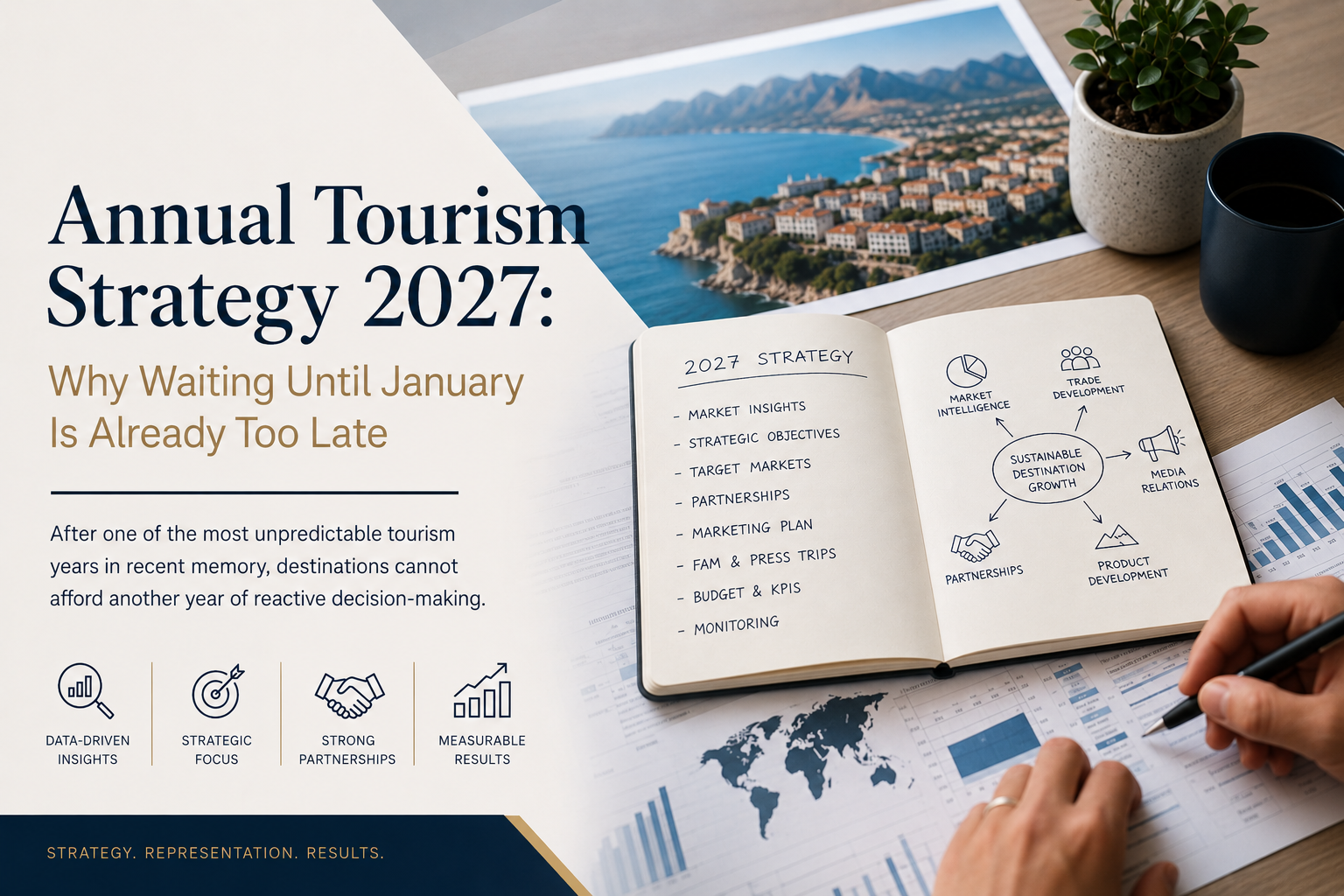
While every destination requires a strategy tailored to its own identity and ambitions, there are certain strategic building blocks that should form the foundation of every planning process. Together, these elements create a roadmap that connects long-term vision with practical implementation, ensuring that every investment supports measurable and sustainable destination growth.
1. Market Intelligence and Strategic Research
Every successful strategy begins with understanding the market before attempting to influence it.
Far too often, destinations begin planning next year’s activities by reviewing last year’s calendar rather than analysing how the tourism landscape has evolved. Yet visitor behaviour, airline connectivity, booking patterns, economic conditions and competitor positioning are constantly changing. A strategy based on outdated assumptions is unlikely to produce future success.
Comprehensive market intelligence should therefore become the starting point of every Annual Tourism Strategy. This includes analysing visitor trends, evaluating source markets, monitoring competitor destinations, identifying emerging travel behaviours and understanding the factors influencing demand. Quantitative data should be complemented by qualitative insights gathered from stakeholders, tourism businesses and international partners to provide a complete picture of the destination’s operating environment.
The objective is not simply to collect information but to transform research into better decision-making.
2. Destination Positioning
Once the market has been understood, the next challenge is defining the destination’s position within it.
Every destination competes for attention in an increasingly crowded marketplace. Beautiful landscapes, historic monuments and attractive beaches are no longer sufficient differentiators on their own. Travellers are seeking authentic experiences, meaningful connections and destinations that communicate a clear identity.
An effective positioning strategy answers three fundamental questions: What makes the destination genuinely distinctive? Which visitor segments are most likely to value those strengths? And how should those strengths be communicated consistently across every touchpoint?
Strong positioning creates clarity not only for visitors but also for tourism businesses, local stakeholders and international partners. It becomes the foundation upon which every marketing campaign, partnership and investment is built.
3. Strategic Objectives
Without clearly defined objectives, even the most ambitious strategy becomes difficult to implement.
Strategic objectives provide direction and establish the outcomes against which success will ultimately be measured. Rather than focusing exclusively on increasing visitor numbers, destinations should define broader ambitions that reflect their long-term vision.
For one destination, success may involve extending the tourism season and reducing dependence on peak summer months. Another may prioritise attracting higher-value visitor segments, increasing average length of stay or strengthening international air connectivity. Others may focus on geographic dispersion, encouraging visitors to explore lesser-known areas, or developing new tourism products that diversify the local economy.
Well-defined objectives ensure that every subsequent decision supports a common purpose.
4. Marketing and Communications
Marketing remains one of the most visible elements of any tourism strategy, but it should never be the starting point.
Once positioning and objectives have been established, destinations can develop an integrated communications plan that supports those priorities. Digital marketing, public relations, social media, content creation, advertising, email marketing, photography, video production and search engine optimisation should work together as parts of a single communications ecosystem rather than as independent initiatives.
Consistency is particularly important. Every campaign, article, photograph and social media post contributes to shaping how the destination is perceived. When communications are aligned with the destination’s strategic positioning, they reinforce one another and gradually strengthen the destination’s brand in the minds of potential visitors.
5. International Trade Development and Representation
For many destinations, sustainable growth depends not only on consumer marketing but also on building strong relationships within the international travel trade.
Trade representation should therefore be approached strategically rather than tactically. Participation in international exhibitions, roadshows, workshops and sales missions should be guided by clearly defined market priorities and commercial objectives. Success is rarely determined by the number of exhibitions attended but by the quality of the relationships developed and the business opportunities generated.
Increasingly, destinations are also recognising the value of year-round engagement with travel advisors, tour operators and destination specialists through virtual B2B meetings, webinars and targeted outreach. These activities help establish relationships long before face-to-face meetings take place, creating stronger commercial outcomes and making every international visit significantly more productive.
6. Media Relations, Press Trips and FAM Trips
Media engagement and familiarisation programmes remain among the most powerful tools available to destinations—but only when they are strategically planned.
Press trips should be designed around specific storytelling opportunities, carefully selected journalists and priority markets rather than broad exposure alone. Similarly, FAM trips should focus on attracting travel professionals with genuine commercial potential rather than maximising participant numbers.
Increasingly, successful destinations are replacing large generic programmes with smaller, highly curated experiences tailored to the interests of carefully selected buyers, media representatives or content creators. When supported by advance outreach, virtual meetings and clear commercial objectives, these initiatives produce stronger relationships, more relevant coverage and greater long-term return on investment.
7. Partnership Development
Tourism is one of the most collaborative industries in the world, and no destination succeeds in isolation.
Airlines, accommodation providers, tour operators, cultural institutions, municipalities, chambers of commerce, sports organisations, universities and local communities all influence the visitor experience. An effective Annual Tourism Strategy identifies opportunities to strengthen these relationships and create partnerships that extend beyond individual campaigns.
The most successful destinations recognise that partnerships are not simply promotional opportunities; they are strategic assets capable of expanding market reach, improving visitor experiences and unlocking new sources of investment and innovation.
8. Tourism Product Development
Marketing can only promote what a destination has to offer.
For this reason, product development should always occupy a central place within an Annual Tourism Strategy.
Whether developing cultural experiences, gastronomy, wine tourism, outdoor adventures, wellness, sports tourism, accessible tourism or creative experiences, destinations should continually evaluate how their tourism products evolve in response to changing visitor expectations. Product development not only increases competitiveness but also creates new reasons for visitors to travel throughout the year and explore different parts of the destination.
9. Budget Allocation and Investment Priorities
One of the most important characteristics of an effective strategy is that it guides financial decision-making.
Budgets should not simply replicate previous spending patterns. Instead, every investment should be evaluated according to its expected contribution towards strategic objectives. This often requires difficult decisions, including redirecting resources from activities with declining impact towards initiatives that offer greater long-term value.
An evidence-based budget reflects both the ambitions of the destination and the realities of its available resources. It ensures that limited funding is invested where it can create the greatest measurable impact rather than being distributed evenly across historical commitments.
10. Performance Measurement and KPIs
A strategy cannot succeed unless progress can be measured.
Performance indicators should extend beyond visitor numbers to include measures such as visitor spending, average length of stay, market diversification, partnership outcomes, media value, trade engagement, digital performance, return on investment and stakeholder satisfaction.
These indicators provide the evidence needed to evaluate which initiatives are delivering value and where adjustments may be required throughout the year.
11. Monitoring, Evaluation and Continuous Improvement
Perhaps the greatest misconception about Annual Tourism Strategies is that they are completed once they are approved.
In reality, the publication of a strategy marks the beginning—not the end—of the planning process.
Tourism is a dynamic industry, and strategies must evolve accordingly. Regular performance reviews, stakeholder consultations and market assessments allow destinations to adapt to changing circumstances while remaining focused on their long-term objectives. This flexibility transforms the strategy from a static planning document into an active management tool that supports better decision-making throughout the year.
Ultimately, these eleven components should never be viewed as independent chapters within a report. They are interconnected elements of a single strategic framework. Market intelligence informs positioning. Positioning shapes objectives. Objectives determine investment priorities. Marketing, trade development, partnerships, product development and media relations all work together to achieve measurable outcomes, while continuous monitoring ensures that the strategy remains relevant as the tourism landscape evolves.
When these elements are aligned, destinations move beyond simply promoting themselves.
They begin managing their future with purpose, confidence and strategic clarity.
Case Study: When Strategy Replaced Routine
One of the most valuable outcomes of an Annual Tourism Strategy is that it encourages destinations to question long-established routines. Activities that have been repeated successfully for years are not necessarily the activities that will deliver the greatest value in the future. As markets evolve, so too must the way destinations invest their time, resources and budgets.
A recent destination strategy developed by Addendum provides a good example of this approach.
Like many mature destinations, the organisation had built its annual tourism programme around a familiar calendar of activities. Every year, a significant portion of the budget was allocated to participation in international tourism exhibitions, large-scale familiarisation trips and a series of promotional initiatives that had gradually become part of the destination’s annual routine. These activities generated visibility and maintained an international presence, but there was growing recognition that greater value could be achieved by focusing less on the quantity of activities and more on their strategic impact.
Rather than recommending an increase in the overall marketing budget, the strategy began by examining the destination’s objectives, priority markets and commercial ambitions. Every existing activity was evaluated against a simple question:
Does this investment contribute directly to the destination’s long-term strategic goals?
The findings led to a different approach.
Instead of participating in every exhibition that had traditionally formed part of the annual calendar, the destination concentrated its international representation on the events most closely aligned with its priority markets and commercial objectives. The resources released through this process were not removed from the budget; they were reinvested in activities capable of building stronger relationships and creating measurable business opportunities throughout the year.
One of the most significant changes involved the destination’s approach to FAM trips.
Historically, familiarisation programmes had focused on attracting larger groups of participants from multiple markets. While these visits generated positive exposure, they also required considerable resources and often included participants whose commercial relevance varied significantly.
Under the new strategy, the destination increased the number of FAM trips organised during the year while deliberately reducing the size of each group. Rather than measuring success by the number of participants, the emphasis shifted towards the quality of those invited. Each programme was designed around carefully selected tour operators, travel advisors and travel professionals who had demonstrated genuine interest in the destination and whose business profile aligned closely with its strategic objectives.
The objective was simple: fewer participants, stronger relationships and greater commercial potential.
Another important innovation was the introduction of structured virtual B2B engagement before each hosted visit.
Instead of inviting buyers who had little previous interaction with the destination, Addendum developed a proactive outreach programme targeting carefully selected travel agents, tour operators and tourism professionals in priority international markets. Through virtual meetings, the destination was able to introduce its tourism products, better understand the interests of potential partners and identify those organisations most likely to generate future business.
By the time participants arrived on a FAM trip, relationships had already begun.
The visit was no longer an introductory meeting but the continuation of an ongoing business conversation. It allowed itineraries to be tailored to the specific interests of each participant, created more meaningful discussions with local tourism businesses and significantly improved the quality of commercial engagement throughout the programme.
The strategy also strengthened the relationship between international representation, media relations and destination marketing. Rather than treating trade exhibitions, press trips, FAM trips and promotional campaigns as separate initiatives managed independently, they became interconnected elements of a single annual strategy. Market representation generated new contacts, virtual B2B meetings qualified potential partners, FAM trips deepened relationships, press visits strengthened destination awareness and ongoing communication ensured that these activities continued to generate value long after each individual event had concluded.
Perhaps the most important lesson from this case study was not that the destination reduced participation in certain activities or increased investment in others.
The real success lay in changing the way decisions were made.
Instead of asking, “What did we do last year?” the destination began asking, “What will create the greatest value next year?”
That shift transformed annual planning from a routine budgeting exercise into a strategic decision-making process.
It also demonstrated an important principle that applies to destinations of every size.
Greater impact is not always achieved through larger budgets or more activities.
More often, it is achieved through better alignment between objectives, partnerships, investment and execution.
Because the true measure of an Annual Tourism Strategy is not how much activity it generates.
It is how effectively every activity contributes to the destination’s long-term success.
Budget Allocation Based on Return on Investment
Every destination, regardless of its size, faces the same reality: resources are finite, while opportunities are virtually endless.
Every year, Destination Management Organizations are presented with dozens of potential initiatives. International exhibitions invite participation, airlines propose joint marketing campaigns, media outlets request collaborations, tour operators seek partnerships, influencers approach destinations with promotional ideas, and new digital platforms promise greater visibility. At the same time, local stakeholders advocate for projects that support their own priorities, while emerging tourism trends continually introduce new opportunities for investment.
The challenge is rarely deciding whether worthwhile opportunities exist.
The challenge is deciding which opportunities deserve investment.
This is precisely where an Annual Tourism Strategy becomes one of the most valuable management tools available to a destination.
Far too often, tourism budgets are developed by adjusting the previous year’s figures. Existing activities receive modest increases or reductions, new initiatives are added where funding permits, and the overall budget gradually evolves without fundamentally questioning whether the existing allocation still reflects the destination’s strategic priorities.
Although this approach is understandable, it often results in budgets that reflect history rather than future opportunity.
A strategic budget should work in the opposite direction.
Instead of asking, “How should we divide this year’s budget?”, destinations should begin by asking, “What outcomes are we trying to achieve, and what investments are most likely to help us achieve them?”
Only once these priorities have been clearly defined should financial resources be allocated.
This represents a significant shift in thinking.
Rather than viewing the budget as an accounting exercise, destinations begin treating it as a strategic investment plan. Every euro, dollar or pound invested should support a clearly defined objective and contribute to measurable long-term value.
That does not necessarily mean funding only the activities that generate immediate commercial returns.
Tourism is a long-term industry, and many of the most valuable investments cannot be measured solely through short-term revenue. Strengthening international relationships, improving destination awareness, developing new tourism products, building trust with the travel trade or investing in destination positioning may all produce benefits that become evident over several years rather than a single tourism season.
For this reason, return on investment should be evaluated more broadly than simple financial calculations.
An effective Annual Tourism Strategy considers multiple dimensions of value. It examines whether an investment contributes to stronger market positioning, increased visitor quality, greater average visitor expenditure, improved seasonality, expanded international partnerships, enhanced media visibility, stronger stakeholder collaboration or the long-term competitiveness of the destination. Financial performance remains important, but it is considered alongside strategic impact rather than in isolation.
This broader perspective often leads to very different investment decisions.
A destination may discover that attending one additional international trade exhibition produces less long-term value than organising a series of targeted virtual B2B meetings with carefully selected tour operators. A large-scale advertising campaign may generate considerable visibility, yet a coordinated programme combining destination representation, trade development, press engagement and highly targeted FAM trips could create stronger commercial relationships while delivering more sustainable results over time.
Likewise, investing in fewer but higher-quality partnerships may produce greater value than supporting numerous smaller initiatives with limited strategic relevance.
These decisions are rarely about spending more.
More often, they are about spending differently.
One of the most common characteristics of high-performing destinations is not the size of their tourism budget but the discipline with which that budget is allocated. Every investment is expected to support a clearly defined strategic objective. Activities that consistently demonstrate value receive continued support, while those that no longer contribute meaningfully to the destination’s priorities are reviewed, redesigned or replaced.
This process requires regular evaluation and, occasionally, difficult decisions.
Long-established initiatives may no longer reflect changing market conditions. Promotional activities that once delivered excellent results may gradually lose their effectiveness. Emerging opportunities may require reallocating resources away from familiar programmes towards innovative approaches better aligned with evolving visitor behaviour.
Such decisions are not always easy, particularly within public-sector organisations where historical commitments, stakeholder expectations and political considerations often influence budget discussions.
Nevertheless, strategic leadership requires the confidence to distinguish between activities that are familiar and those that are genuinely effective.
An evidence-based budget is therefore not simply a financial document.
It is a reflection of the destination’s priorities, ambitions and confidence in its long-term vision.
Ultimately, every allocation should answer one fundamental question:
If we invest in this activity, how will it help our destination achieve the future we are trying to build?
If that question cannot be answered clearly, the investment deserves to be reconsidered.
Because the objective of an Annual Tourism Strategy is not to ensure that every available budget line is spent.
It is to ensure that every investment creates meaningful value for the destination, its visitors, its businesses and its communities.
The destinations that achieve the greatest long-term success are rarely those with the largest budgets.
More often, they are the destinations that understand where every investment can make the greatest difference—and have the discipline to invest accordingly.
Press Trips, FAM Trips & International Representation
International visibility is one of the primary objectives of almost every destination. Whether the goal is attracting new visitors, entering new markets, strengthening relationships with the travel trade or improving global brand awareness, destinations invest considerable resources in activities designed to increase their international presence.
Among the most widely used initiatives are participation in international tourism exhibitions, destination representation in overseas markets, press trips, familiarisation (FAM) trips, sales missions and media collaborations. Individually, each of these activities has the potential to create significant value.
However, their success depends far less on how well they are organised than on how well they are integrated into the destination’s overall strategy.
One of the most common mistakes in destination marketing is treating these initiatives as independent projects. A destination attends an international trade show because it has always participated. A press trip is organised because budget has been allocated. A FAM trip is developed once a year with a large number of participants representing different markets, while media collaborations are often evaluated according to the number of articles published rather than their strategic relevance.
Although these activities may generate positive results individually, they rarely achieve their full potential when they are planned in isolation.
An effective Annual Tourism Strategy approaches international representation very differently.
Rather than asking, “Which exhibitions should we attend?” it begins with a more fundamental question:
Which international markets offer the greatest opportunity for sustainable growth, and what is the most effective way to build our presence within them?
The answer may include trade exhibitions, but it may also involve strategic market representation, targeted B2B outreach, virtual sales meetings, media engagement, hosted buyer programmes, airline partnerships or carefully selected familiarisation visits.
The objective is not to maximise activity.
The objective is to maximise relationships.
Relationships remain the most valuable asset in international tourism development.
While digital marketing can inspire travellers and advertising can increase visibility, long-term commercial growth is often driven by trusted partnerships between destinations, tour operators, travel advisors, airlines, destination management companies and international media. Building these relationships requires consistency, credibility and regular engagement—not simply one annual meeting at an international exhibition.
This is where international representation becomes particularly valuable.
Rather than limiting market engagement to a few days each year, destinations benefit from maintaining an ongoing presence in their priority markets. Continuous communication with travel trade professionals, regular market intelligence, proactive outreach and year-round relationship management enable destinations to remain visible long after major events have concluded.
The same strategic thinking should guide the planning of FAM trips.
Traditionally, many destinations have measured the success of a familiarisation programme by the number of participants invited. Larger groups often appear more productive because they generate greater activity within a shorter period. In reality, however, larger groups also require more resources, limit opportunities for personalised engagement and frequently include participants whose commercial potential varies considerably.
Increasingly, leading destinations are moving towards a different model.
Instead of organising one large annual familiarisation programme, they develop several smaller, carefully curated FAM trips throughout the year. Each programme is designed around a specific source market, tourism product or commercial objective, while participants are selected according to their ability to generate meaningful business for the destination.
The emphasis shifts from quantity to quality.
A similar evolution is taking place in media relations.
The value of a press trip is no longer determined simply by the number of journalists attending or the volume of articles published. More important is whether the invited media genuinely influence the destination’s priority audiences, whether the stories align with the destination’s positioning and whether the resulting coverage supports long-term strategic objectives.
The most successful press visits are therefore highly targeted. They are built around compelling story angles, carefully designed itineraries and authentic experiences that reflect the destination’s identity rather than attempting to showcase everything within a few days.
Perhaps one of the most significant developments in recent years has been the growing importance of pre-engagement.
At Addendum, we have found that some of the most productive FAM trips and sales missions begin long before participants arrive at the destination.
Through proactive outreach, virtual B2B meetings and structured relationship development, destinations have the opportunity to introduce themselves to carefully selected travel agents, tour operators and travel advisors months in advance. These early conversations allow both parties to understand each other’s objectives, identify genuine commercial opportunities and determine whether a hosted visit is likely to create long-term value.
As a result, the FAM trip itself becomes something entirely different.
It is no longer an introduction.
It becomes the continuation of an already established business relationship.
Participants arrive with a clear understanding of the destination, meetings are tailored to their commercial interests and local stakeholders engage with partners who have already demonstrated genuine commitment to future collaboration.
This approach not only improves the quality of business discussions but also ensures that the destination invests its resources where they are most likely to generate measurable outcomes.
Importantly, none of these initiatives should be viewed as isolated investments.
A successful Annual Tourism Strategy connects international representation, trade exhibitions, virtual B2B meetings, press engagement, FAM trips, destination marketing and partnership development into a single, coordinated framework.
A conversation initiated during a trade exhibition may lead to a virtual meeting several weeks later. That meeting may identify a promising tour operator who is subsequently invited on a specialised FAM trip. The hosted visit may result in new itineraries, marketing collaborations or commercial agreements that are then supported by targeted consumer campaigns and media exposure within the same market.
Each activity reinforces the next.
Each investment contributes towards the same strategic objective.
This integrated approach not only improves efficiency but also creates a much stronger return on investment than treating every initiative as an independent project.
Ultimately, destinations should not measure success by the number of exhibitions attended, the number of journalists hosted or the size of a FAM trip.
They should measure success by the strength of the relationships they build, the partnerships they develop and the long-term value those relationships generate for the destination.
Because international representation is not about being present everywhere.
It is about being present where it matters most, with the right partners, at the right time and for the right reasons.
That is the difference between promoting a destination and strategically developing its international market presence.
KPIs, Monitoring & Quarterly Review
An Annual Tourism Strategy should never be considered complete the day it is approved.
In reality, approval marks the beginning of a much more important phase: implementation, measurement and continuous improvement.
One of the most common reasons tourism strategies fail is not because they were poorly designed, but because they were never actively managed once implementation began. Months of research, stakeholder consultations and planning often result in a comprehensive document that is presented, approved and then gradually forgotten as day-to-day operational priorities take over. Teams become focused on delivering activities, while the strategy itself slowly transitions from a management tool into a reference document that is consulted only occasionally.
In an industry as dynamic as tourism, this approach is no longer sustainable.
Markets evolve continuously. Airline connectivity changes. Economic conditions fluctuate. New competitors emerge, consumer behaviour shifts and unforeseen global events can rapidly alter travel demand. A strategy that remains static throughout the year risks becoming progressively less relevant with every passing month.
For this reason, successful destinations increasingly treat their Annual Tourism Strategy as a living framework rather than a fixed annual plan.
Instead of asking whether every activity has been completed, they regularly evaluate whether those activities are producing the outcomes the destination originally set out to achieve. This subtle shift changes the focus from measuring effort to measuring impact.
Meaningful performance measurement begins with selecting the right Key Performance Indicators (KPIs).
For many years, tourism organisations relied heavily on visitor arrivals as the primary measure of success. While visitor numbers remain an important indicator, they rarely tell the complete story. A destination may welcome more visitors than ever before while simultaneously experiencing lower visitor spending, shorter stays, increased seasonality, overcrowding or declining resident satisfaction. Conversely, another destination may record fewer visitors yet achieve significantly greater economic value by attracting higher-spending market segments or extending the tourism season.
An effective Annual Tourism Strategy therefore measures success across multiple dimensions.
Performance indicators should reflect the strategic priorities established at the beginning of the planning process. If the objective is to strengthen international market presence, indicators may focus on trade partnerships established, new tour operator programmes developed or international market growth. If the priority is improving destination positioning, media reach, brand perception, digital engagement and share of voice may provide more meaningful insights. Where product development is a strategic objective, success may be measured through visitor participation, stakeholder engagement or the commercial performance of newly developed tourism experiences.
The purpose of KPIs is not to create more reporting.
Their purpose is to improve decision-making.
Well-designed indicators provide management teams with objective evidence of what is working, what requires adjustment and where future investment is likely to produce the greatest return. They reduce reliance on assumptions and allow strategic discussions to be guided by measurable outcomes rather than individual opinions.
Equally important is the frequency with which performance is reviewed.
Many destinations evaluate their results only once the tourism season has concluded. While annual reviews remain valuable, they often identify opportunities long after it is possible to respond. A more effective approach is to establish a structured programme of quarterly strategy reviews.
Quarterly reviews create regular opportunities to reassess market developments, evaluate progress towards strategic objectives and respond proactively to emerging opportunities or challenges. They also encourage stronger communication between tourism authorities, municipalities, private-sector stakeholders and international partners, ensuring that strategic decisions continue to reflect changing market conditions rather than assumptions made months earlier.
These reviews do not necessarily require major revisions to the strategy. In many cases, small adjustments are sufficient. A source market may demonstrate stronger demand than originally anticipated, justifying additional promotional investment. A planned campaign may underperform and require a different creative approach. New airline connectivity may create opportunities in a market that was not previously considered a priority. A successful press trip may reveal significant media interest in a tourism product that deserves greater strategic emphasis.
Rather than viewing these developments as disruptions, strategically managed destinations treat them as opportunities to refine their plans while remaining aligned with their long-term objectives.
Monitoring should extend beyond marketing performance alone.
An effective review process considers the destination as a whole. Visitor satisfaction, stakeholder feedback, trade engagement, partnership development, media impact, digital performance, tourism product evolution, budget utilisation and progress towards sustainability objectives all contribute valuable insight into whether the strategy is achieving its intended outcomes.
Perhaps most importantly, regular monitoring creates organisational learning.
Every campaign, trade exhibition, press trip, FAM trip, partnership or international representation activity becomes an opportunity to generate knowledge that strengthens future decision-making. Instead of repeating activities because they have always been part of the annual programme, destinations gradually build an evidence base that identifies which investments consistently create value and which require reconsideration.
Over time, this process transforms annual planning itself.
Each year’s strategy is no longer developed from scratch. It evolves from the lessons, data and experience gathered throughout the previous year. Decisions become more informed, budgets become more focused and the strategy becomes increasingly aligned with the destination’s long-term ambitions.
Ultimately, the purpose of monitoring is not simply to evaluate performance.
It is to ensure that the destination continues learning, adapting and improving.
Because in today’s tourism environment, the most successful destinations are not necessarily those that have the perfect strategy.
They are the ones that continually refine it.
As management expert Peter Drucker famously observed, “What gets measured gets managed.” In destination management, an equally important principle also applies:
What gets reviewed gets improved.
An Annual Tourism Strategy should therefore never be seen as a document that defines the year ahead.
It should become the management framework that guides every important decision throughout it.
Strategy Before Activity
Throughout this guide, one message has emerged repeatedly: successful destinations do not begin by asking what they should do next. They begin by understanding what they are trying to achieve.
Although this distinction may appear subtle, it fundamentally changes the way destinations plan, invest and compete.
Too often, annual tourism planning starts with activities. Which exhibitions should we attend? Which campaigns should we launch? How many press trips should we organise? Which influencers should we invite? Should we invest more in digital advertising? How many FAM trips should we schedule this year?
These are all important questions.
The problem is that they are being asked too early.
Activities should never determine strategy.
Strategy should determine activities.
When destinations begin with tactics, every initiative competes for budget, attention and organisational resources without a common framework for evaluating its value. Decisions are often influenced by habit, familiarity or short-term expectations rather than by evidence and clearly defined objectives. The result is a calendar filled with worthwhile initiatives that may individually perform well but collectively fail to move the destination towards its long-term ambitions.
A strategy-first approach reverses this process.
It begins by establishing a clear vision for the destination and defining the outcomes that matter most. Only then does it evaluate which activities are capable of delivering those outcomes. Every exhibition, every marketing campaign, every partnership, every press trip, every FAM trip and every investment is assessed according to one fundamental question:
How does this activity contribute to the future we want to create for our destination?
When this question becomes the basis of decision-making, priorities become clearer.
Budgets become more focused.
Partnerships become more purposeful.
Marketing becomes more consistent.
Trade representation becomes more targeted.
Media engagement becomes more relevant.
Tourism product development becomes more strategic.
Most importantly, every initiative begins reinforcing the others rather than competing for attention.
This integrated way of thinking also creates greater resilience.
Tourism will continue to change. Markets will evolve, traveller expectations will shift, new technologies will emerge and unexpected challenges will inevitably influence the industry. Destinations that rely primarily on annual activity calendars often struggle to respond because every initiative has already been planned and every budget line has already been committed.
By contrast, destinations guided by strategy are better prepared to adapt. Their long-term objectives remain consistent, but the activities they choose to achieve those objectives can evolve as circumstances change. Strategy provides direction without restricting flexibility.
This is one of the defining characteristics of high-performing destinations around the world.
They do not chase every opportunity.
They evaluate opportunities through the lens of strategy.
They do not participate in every exhibition because it is available.
They participate because it supports a clearly defined market objective.
They do not organise press trips simply because funding exists.
They invite journalists whose audiences align with their priority markets and whose stories reinforce the destination’s positioning.
They do not measure the success of a FAM trip by the number of participants.
They measure it by the quality of relationships established, the business opportunities created and the long-term partnerships that emerge.
In other words, they understand that activities are not objectives.
They are tools.
And like every tool, their value depends entirely on how and why they are used.
This is the philosophy that underpins every successful Annual Tourism Strategy.
Marketing is important.
Trade development is important.
International representation is important.
Press relations are important.
FAM trips are important.
Digital campaigns are important.
Partnerships are important.
But none of these initiatives should exist in isolation.
Their true value is realised only when they are connected through a shared strategic vision that guides every investment, every partnership and every decision throughout the year.
At Addendum, this belief shapes the way we work with destinations.
We do not begin by recommending activities.
We begin by asking questions.
Where does the destination want to be in five years?
Which markets offer the greatest long-term opportunity?
What makes the destination genuinely distinctive?
Which partnerships can accelerate sustainable growth?
Where should resources be invested to create the greatest long-term value?
Only after these questions have been answered do we begin designing the activities that will bring the strategy to life.
Because strategy should never be written to justify a marketing plan.
A marketing plan should be created to deliver a strategy.
That difference may seem small.
In reality, it changes everything.
The destinations that will lead the next decade of tourism will not necessarily be those with the biggest budgets, the most campaigns or the highest number of promotional activities.
They will be the destinations that make the best strategic decisions, invest with purpose and remain disciplined enough to ensure that every activity supports a clearly defined vision for the future.
Because destinations are not transformed by individual campaigns.
They are transformed by the decisions that connect those campaigns into a strategy.
And that is why strategy must always come before activity.
Annual Tourism Strategy 2027
Is your destination ready to move from activity to strategy?
A successful 2027 strategy should begin before budgets and annual activities are finalised. In a complimentary strategic session, we will discuss your destination’s priorities, current challenges and the areas where a more focused approach could create greater measurable value.
- Strategic priorities
- Market opportunities
- Budget direction
- International representation
- Press & FAM trips
- Partnership development